


Think robotics is only for college-bound engineers?
FIRST Tech Challenge (FTC) proves otherwise: it’s a competitive robotics league for students in grades 7–12 where teams design, build, and program real robots to solve game challenges.
This post breaks down how FTC works, the season timeline, team roles, and robot design essentials.
You’ll also get practical tips for coaches, parents, and students who want to join or build a stronger team.
Understanding the FIRST Tech Challenge Program

FIRST Tech Challenge is a robotics competition for students in grades 7 through 12. Middle and high school teams design, build, program, and compete with robots. The program throws engineering problems at students while teaching real-world skills that matter long after the competition ends. FTC runs as a structured competition system where teams advance through local qualifiers, regional championships, and eventually to the FIRST Championship, which hosts hundreds of teams across multiple days and venues.
FTC competitions are organized into named divisions that each run independent tournament brackets before converging at championship finals. The 2026 FIRST Championship schedule, for example, spans April 29 through May 2 and includes seven divisions: da Vinci, Edison (sponsored by GE Aerospace), Franklin (sponsored by John Deere), Goodall (sponsored by BAE Systems), Jackson (sponsored by Qualcomm), Lovelace (sponsored by CrunchLabs), and Ross. Each division runs its own set of Qualification Matches to seed teams into rankings, followed by alliance selection and Playoff rounds. Teams and spectators can track performance through official pages that publish Qualification Rankings, match schedules, and playoff brackets in real time as events progress.
Official FTC events provide multiple result categories that teams and families monitor throughout competition day. Event pages display Teams Advancing to track which squads have earned spots at the next level, Event Results that aggregate scores and outcomes, and Award Winners that recognize excellence in engineering, community impact, and competitive performance. All divisions follow the same structure, ensuring fairness and allowing direct performance comparisons across regions and brackets.
Core elements of FTC participation include:
Team collaboration. Students work in groups of up to 15, dividing responsibilities across design, build, programming, outreach, and documentation.
Engineering tasks. Teams prototype mechanisms, select materials, assemble drive trains, and integrate sensors into a working robot.
Coding. Programming is required for autonomous routines and driver-controlled operation, using languages like Java or visual Blocks.
Match structure. Each match includes a 30-second autonomous period followed by a driver-controlled phase, with alliances of two teams competing together.
Judging. Teams prepare portfolios and presentations to be evaluated on innovation, documentation, community outreach, and engineering methodology.
FIRST Tech Challenge Season Structure and Timeline

The FTC season follows a predictable annual cycle. It begins in late summer and wraps up at the FIRST Championship the following spring. Teams register during the summer, attend kickoff events in September where the new game challenge is revealed, then spend about three to four months in a build and practice phase before entering competition brackets. Regional programs publish season resources early in the cycle. San Diego FTC, for instance, releases 2025–26 Regional Information and 2025–26 Judging Guidelines to help teams prepare. SoCal FTC typically closes team registration for the upcoming season by late summer or early fall to finalize rosters and league assignments.
Major events anchor the competition calendar at both regional and championship levels. The FIRST Championship runs a multi-day schedule labeled “FIRST Champs Live!” and spans dates such as April 29, April 30, May 1, and May 2, hosting division tournaments simultaneously across a single venue or campus. Regional premier events occur in the weeks leading up to the Championship. The Western Edge Premier Event in Long Beach, California, is scheduled for May 28–31 and will host an 88-team field tournament, serving as a qualifier and showcase for top-performing teams in Southern California.
Typical FTC yearly flow:
Kickoff (September). Game reveal, rule manual release, and part ordering begins.
Build Season (September–January). Design, prototype, assemble, and program the robot while preparing judging materials.
League Meets (December–February). Teams compete in scrimmages and ranked league matches to practice and earn qualification points.
Regional Qualifiers (January–March). Advancement tournaments that determine which teams move to state or super-regional events.
State/Super-Regional Championships (March–April). Multi-day competitions where top teams earn invitations to the FIRST Championship.
FIRST Championship (late April–early May). Division tournaments, finals, and awards ceremonies that close the season.
FIRST Tech Challenge Team Structure and Roles
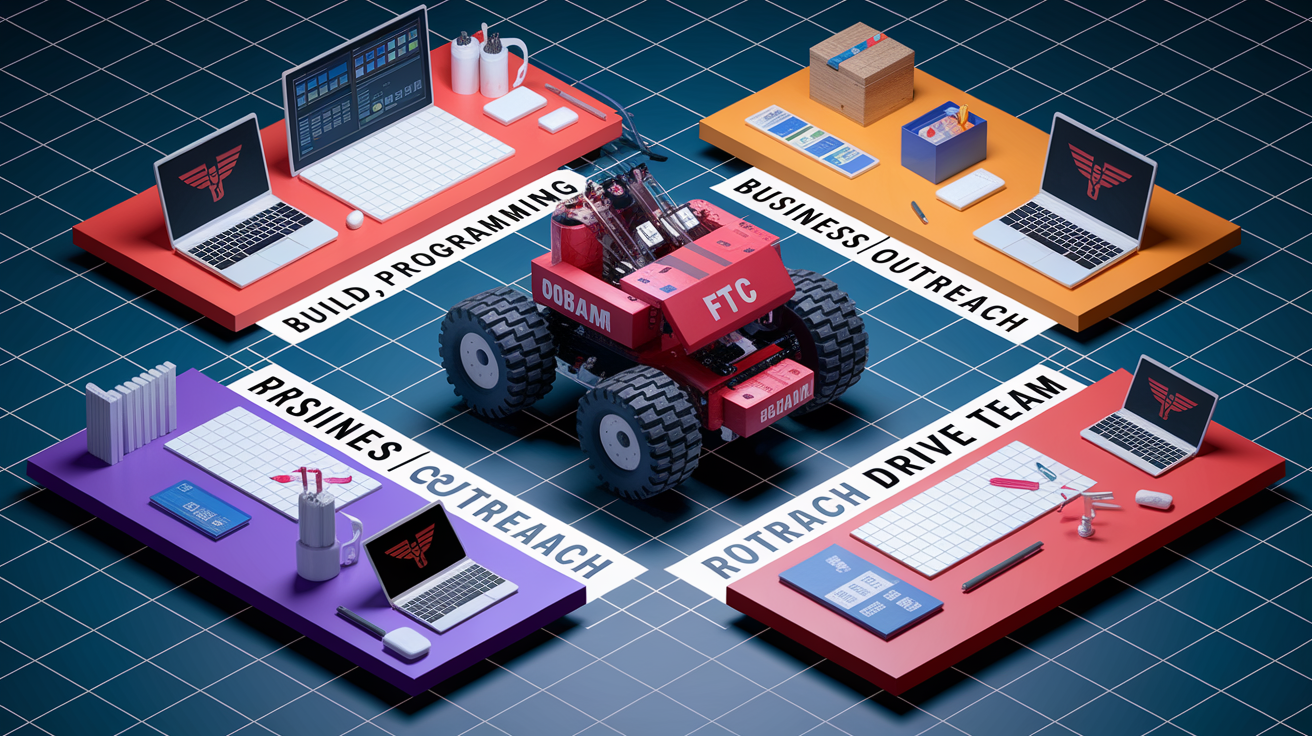
FTC teams typically organize into specialized subteams that divide the workload across engineering, programming, business operations, and community outreach. A common structure includes a build subteam focused on mechanical design and assembly, a programming subteam responsible for autonomous and driver-control code, a business/outreach subteam that handles fundraising and community engagement, and a drive team that practices and competes during matches. Student leadership roles such as team captain, project manager, and lead engineer help coordinate efforts and make sure deadlines are met. Younger or newer members rotate through positions to build experience across all areas of the program.
Adult mentors and coaches provide guidance, safety oversight, and access to tools and workspace. But FTC rules require that students lead the design and decision-making process. Coaches help teams set goals, manage schedules, arrange transportation to events, and navigate registration and compliance requirements. They don’t build or program the robot themselves. Many successful teams also recruit technical mentors with backgrounds in engineering, computer science, or manufacturing who can teach specific skills such as CAD modeling, PID tuning, or machine shop safety without taking over student ownership of the project.
Participation in FTC builds a set of soft skills that students apply in school, college, and careers long after the competition season ends. San Diego FTC programs emphasize workforce readiness by highlighting the real-world competencies that emerge from team collaboration and competition pressure.
Key soft skills developed in FTC:
Communication. Presenting to judges, coordinating with alliance partners, and documenting engineering decisions.
Conflict resolution. Managing disagreements over design choices, strategy, and resource allocation within the team.
Time management. Balancing build deadlines, schoolwork, practice schedules, and event preparation.
Problem-solving. Diagnosing mechanical failures, debugging code, and adapting strategy based on match performance and opponent analysis.
Robot Design and Build Essentials for FTC Teams

FTC robots must fit within an 18-inch starting cube at the beginning of each match. They’re built using a combination of structural kits, custom-fabricated parts, and commercial off-the-shelf components that comply with the official parts list. Teams design around the annual game challenge, which changes every September and defines scoring tasks such as moving game pieces, climbing structures, or delivering objects to specific zones on the field.
Mechanical Systems
The foundation of any FTC robot is its drive train, which determines speed, maneuverability, and pushing power. Common drive configurations include tank drive (four or six wheels, simple and robust), mecanum drive (omnidirectional movement using specialized wheels), and swerve drive (independent steering per wheel, offering maximum agility).
Teams select materials based on weight, strength, and ease of fabrication. Aluminum extrusion and channel are popular for frames due to their rigidity and compatibility with metric and imperial fasteners. 3D-printed parts are used for custom brackets, gears, and lightweight components. Intake mechanisms such as roller claws, conveyor belts, or compliant wheels capture and control game elements. Lift or arm systems extend the robot’s reach using linear slides, cascade rigging, or rotational joints powered by motors and servos. Gearing decisions balance torque and speed. Higher gear ratios provide more lifting force and lower ratios enable faster movement.
Electrical & Control Systems
FTC robots are controlled by the REV Robotics Control Hub or Expansion Hub. It serves as the brain of the system by running the robot’s code, managing sensor inputs, and sending commands to motors and servos. Teams wire DC motors for drive and actuation, servo motors for precise angular control, and sensors such as color sensors, distance sensors, touch sensors, and the built-in Inertial Measurement Unit (IMU) that tracks orientation and rotation.
Proper wiring practices include using labeled connectors, securing cables with zip ties or cable channels to prevent snags, and distributing power to avoid voltage drops that can cause brownouts during high-current maneuvers. Motor controllers are integrated into the hubs, simplifying the electrical layout compared to other robotics platforms. But teams must still plan wire routing, battery placement, and switch access to ensure reliable operation and fast repairs in the pit.
Build Workflow & Prototyping
Successful FTC teams prototype early and often, testing individual mechanisms before committing to a final robot design. The prototyping phase involves building rough versions of intake arms, lifts, or drive trains using spare parts or cardboard mockups, then iterating based on performance tests and failure analysis.
Computer-Aided Design (CAD) software such as Onshape, Fusion 360, or SolidWorks allows teams to model the entire robot in 3D, check for part interference, calculate center of mass, and generate cut lists for fabrication. After CAD approval, teams move to fabrication and assembly, cutting metal with bandsaws or chop saws, drilling mounting holes, and assembling subsystems on a modular chassis that allows for quick repairs and adjustments. The iteration cycle continues throughout the season as teams refine mechanisms, reduce weight, and tune for speed and reliability based on practice matches and scrimmage feedback.
| Component | Purpose |
|---|---|
| Mechanical Systems | Provide mobility, manipulation, and structural support using drive trains, arms, and intakes |
| Electrical & Control Systems | Execute code, read sensors, and power motors via REV Hub, wiring, and battery management |
| Software Components | Enable autonomous routines, driver control, and real-time decision-making through Java or Blocks code |
FIRST Tech Challenge Programming and Autonomous Systems

FTC robots operate in two distinct modes during each match: a 30-second autonomous period where the robot runs pre-programmed routines without driver input, and a driver-controlled period where students use gamepads to steer, manipulate, and score. Programming is essential for both phases. Teams choose between Java-based coding using Android Studio and the FTC SDK, or Blocks, a visual drag-and-drop environment built on Google’s Blockly framework that’s easier for beginners but less flexible for advanced control logic. Java is the preferred language for competitive teams due to its support for object-oriented design, custom libraries, and fine-tuned sensor integration. Blocks is commonly used by rookie teams or for rapid prototyping before transitioning to text-based code.
Championship-level performance relies on accurate autonomous routines that can navigate the field, detect game elements, and score points reliably without human intervention. The autonomous phase is often the highest point-density period of the match, rewarding teams that can execute complex tasks such as delivering pre-loaded game pieces, parking in designated zones, or activating field elements. To pull this off, teams use sensor feedback and odometry systems that track the robot’s position in real time, allowing the code to make corrections and adapt to variations in starting position or field conditions. Championship divisions all provide separate result pages for Qualification Matches, Rankings, and Playoffs. The scoring software tracks autonomous and TeleOp points independently, making autonomous performance a visible and strategic part of team rankings and alliance selection.
Essential programming tasks for FTC teams:
IMU usage. Read heading, pitch, and roll from the Inertial Measurement Unit to maintain orientation during turns and correct drift.
Odometry. Calculate position using wheel encoders or dead-wheel pods to enable field-relative navigation and waypoint following.
Trajectory planning. Define smooth paths using libraries like Road Runner that combine motion profiling with real-time feedback for accurate driving.
PID tuning. Adjust Proportional, Integral, and Derivative constants to create responsive, stable control loops for heading correction, arm position, and drive speed.
TeleOp control mapping. Assign gamepad buttons and joysticks to robot functions such as intake, lift, and drive modes, with optional macros for repeated tasks.
Best practices in debugging and testing include logging sensor data and motor outputs to the Driver Station or Android Studio’s Logcat, running isolated tests of individual subsystems before full integration, and simulating match conditions during practice by timing autonomous runs and introducing random start positions or field element placements. Teams should version-control their code using Git or another source-control system to track changes and revert to stable builds when new features introduce bugs. Maintain a checklist of pre-match code uploads, battery swaps, and IMU calibrations to avoid disqualifications or unexpected behavior during competition.
Competition Format and Scoring in the FIRST Tech Challenge

FTC matches are played on a 12-foot by 12-foot square field with alliances of two teams competing against another pair in head-to-head scoring challenges. Each match begins with a 30-second autonomous period where robots operate on pre-programmed instructions, followed by a two-minute driver-controlled period where students use gamepads to steer and manipulate the robot. Points are awarded for tasks such as delivering game pieces to scoring zones, parking in designated areas, or activating field elements. Autonomous actions typically earn bonus multipliers to reward accurate programming. At the end of the match, referees tally scores and apply minor or major penalties for rule violations such as pinning, exceeding size limits, or interfering with opponents outside the allowed contact zones.
Qualification Matches seed teams into Qualification Rankings based on a combination of win-loss record, ranking points, and tiebreaker metrics such as total autonomous points or highest match score. Most FTC events run a round-robin or partial round-robin schedule where every team plays a set number of matches against rotating opponents and partners, ensuring that rankings reflect overall performance rather than a single playoff bracket. After qualifications conclude, the top-ranked teams select alliance partners in a draft process called alliance selection. The first-place team picks a partner, then second place picks, and so on until all playoff alliances are filled. Playoff Information pages track which alliances advance through quarterfinals, semifinals, and finals, with bracket-style elimination determining the tournament champion and which teams earn advancement invitations to the next level.
Common scoring strategies:
Maximize autonomous points. Prioritize high-value autonomous tasks and consistent execution. Autonomous scores often serve as tiebreakers and ranking point sources.
Cycle time reduction. Practice fast, repeatable pickup and delivery routines to increase the number of scoring actions completed during the driver-controlled period.
Alliance coordination. Communicate with partners before matches to divide responsibilities, avoid redundant actions, and cover weaknesses in each robot’s capabilities.
Endgame focus. Design mechanisms specifically for endgame tasks such as climbing or parking, which often carry large point values and can swing close matches.
Preparing for FTC Events and Competition Day

Event preparation begins days or weeks before competition day. Teams conduct final robot inspections to confirm compliance with size, weight, and parts rules, pack spare parts and tools for pit repairs, and rehearse judging presentations that explain engineering decisions, community outreach, and team sustainability. Teams should arrive at the venue early to complete official robot inspection, where volunteers check dimensions, battery labeling, mechanical safety, and software configuration to ensure the robot meets all rules. Inspection schedules are published in advance and often include narrow time windows such as Thursday 3:30–6:00 pm or Friday 7:00–10:00 am at large events, so teams must plan arrival times to avoid missing their slot and being excluded from early matches.
Competition day workflow starts with check-in at the pit area, where teams claim their assigned table, unload tools and spare parts, and begin final testing and charging backup batteries. The pit serves as the team’s home base throughout the event. FTC rules require all work to be done in the pit unless the robot is queued for a match or inspection. Teams receive a match schedule showing their queue times, opponents, and alliance partners. They must report to the queueing area at least two matches before their own to upload code, verify gamepad pairing, and complete field-side inspections. Between matches, teams return to the pit to analyze performance, make repairs, adjust code, and prepare for judging interviews, which are typically conducted in separate judging rooms on a schedule provided at check-in.
Event-day checklist:
Inspection prep. Measure robot dimensions, label battery with team number, ensure all parts are on the legal list, and test code upload and gamepad connection.
Safety rules. Wear closed-toe shoes and safety glasses in the pit, keep the robot powered off except during approved testing times, and follow venue guidelines for tool use.
Pit setup. Organize spare parts, charge stations, and tools on the team table, display team number and branding, and keep aisles clear for foot traffic and volunteer access.
Check-in timing. Arrive at least one hour before inspection opens, confirm match schedule, and locate judging rooms, queueing areas, and field entrances.
Pre-match routine. Upload fresh code before each match, check battery voltage, verify all mechanisms move freely, and review strategy with alliance partner at the queueing table.
Post-match debrief. Record match scores, note mechanical failures or code bugs, and make targeted repairs or adjustments before the next queue time.
Fundraising, Scholarships, and Support Networks in FTC
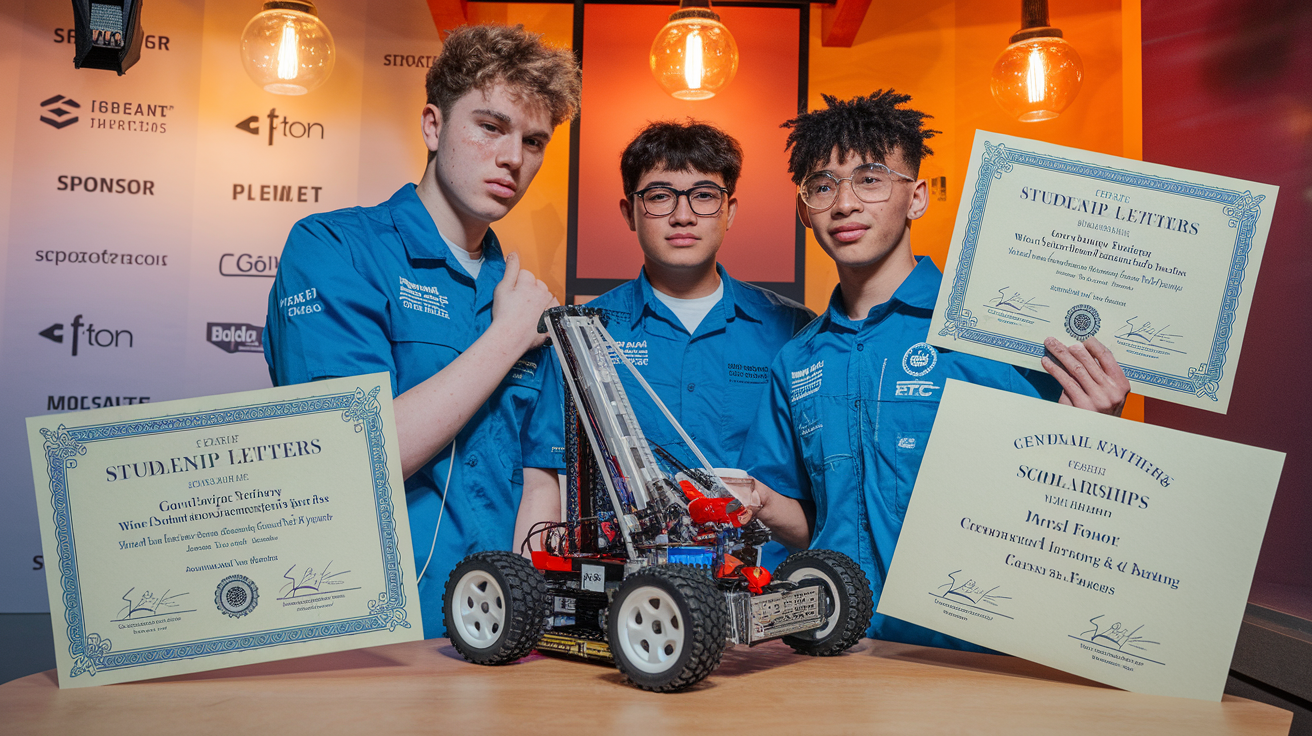
FTC teams operate with annual budgets that cover registration fees, robot parts, travel to events, tools, and team branding. Costs vary widely based on team size, ambition, and regional pricing. Registration alone can run several hundred dollars per season, and competitive teams often spend $3,000 to $10,000 or more when factoring in custom-fabricated parts, travel to multi-day championships, and professional development for mentors and students. To offset these costs, teams pursue a mix of fundraising activities such as hosting community events, selling team merchandise, running concession stands, and applying for grants from local businesses, STEM-focused nonprofits, and corporate giving programs. Regional support structures such as Robotics Inspiring Science and Engineering (RISE), Inc., a 501(c)(3) organization, and its affiliated STEAM Hub provide logistical and financial backing to help new and under-resourced teams participate.
Participation in FTC opens access to significant scholarship opportunities that can reduce or eliminate the cost of college for dedicated students. San Diego FTC lists over $80,000,000 in scholarships available from more than 200 scholarship providers, many of which specifically target FIRST alumni or students with demonstrated STEM involvement and leadership. These scholarships range from small one-time awards to full-tuition packages offered by universities that partner with FIRST. Applications typically require documentation of FTC participation, engineering portfolio work, and essays describing problem-solving experiences or team leadership. The financial benefits extend beyond scholarships. Students who complete multiple FTC seasons and advance to leadership roles often receive recruitment attention from college engineering programs and internship sponsors who value hands-on robotics experience.
Examples of fundraising and sponsorship methods:
Local business partnerships. Approach companies for cash sponsorships, in-kind donations of materials, or workspace access in exchange for logo placement and community recognition.
Grant applications. Apply to STEM education foundations, corporate giving programs, and community funds that support youth robotics, often requiring a detailed budget and impact statement.
Crowdfunding campaigns. Use platforms like GoFundMe or school-based giving portals to reach alumni, family networks, and local supporters with specific funding goals and progress updates.
Fundraising events. Organize car washes, bake sales, or robot demonstrations at school functions, farmers markets, or STEM nights to raise small amounts and build community awareness.
Advancement, Awards, and Pathways to the FIRST Tech Challenge Championship

Teams advance from local competitions to the FIRST Championship by earning specific qualifications through performance and awards at regional and state-level tournaments. Most regions use a combination of tournament wins, high rankings, and judge-selected advancement awards to determine which teams receive invitations to the next tier of competition. Winning a regional qualifier or finishing in the top alliance at a league championship often guarantees a spot at the state or super-regional event. Teams that demonstrate exceptional engineering, community impact, or sportsmanship may earn wild-card invitations through awards such as the Inspire Award or Connect Award even if they don’t win on the field. Championship event pages include a Teams Advancing section that lists which squads have secured their invitations, providing transparency and allowing teams to track their progress toward the season’s ultimate goal.
Judging is a critical component of FTC advancement and occurs at every level of competition, from league meets to the FIRST Championship. Teams prepare an Engineering Portfolio that documents their design process, community outreach, team sustainability plan, and season goals, then present to a panel of judges in a 10-minute interview where they explain their robot, defend design choices, and describe their team’s impact beyond competition scores. San Diego FTC provides 2025–26 Judging Guidelines that outline what judges look for in each award category. Teams are evaluated on criteria such as innovation, documentation quality, problem-solving methodology, gracious professionalism, and the ability to articulate engineering trade-offs. Judges deliberate after interviews and match observations to select award winners. The highest honor, the Inspire Award, is typically reserved for the team that best embodies the complete FTC experience: competitive performance, well-documented engineering, strong community engagement, and a sustainable plan for future seasons.
| Award | Key Criteria |
|---|---|
| Inspire Award | Balanced excellence across engineering, community outreach, competitive performance, and team sustainability; often grants advancement to the next level |
| Think Award | Outstanding engineering portfolio, clear documentation of design iterations, innovative problem-solving, and effective use of CAD, prototyping, and testing |
| Connect Award | Strong community partnerships, outreach to underserved populations, promotion of STEM education, and a plan for long-term team growth and mentorship |
Final Words
We jumped straight into what the program is, the season timeline and division setup, team roles, robot design and programming, scoring, event prep, and funding paths.
Use the checklists: prep your robot, practice autonomous modes, assign clear roles, and lock in mentors and sponsors.
If you’re stepping into FIRST or helping a school team, the first tech challenge gives a clear path to build skills, compete, and grow — get planning and enjoy the process.
FAQ
Q: What do you do in the FIRST Tech Challenge?
A: The FIRST Tech Challenge has teams design, build, program, and compete with robots; students handle mechanical, electrical, coding, strategy, pit duties, present to judges, and play qualification matches and playoffs.
Q: Is FTC or FRC harder?
A: Whether FTC or FRC is harder depends on scale and resources: FRC uses bigger robots, more complex systems, and higher time and cost commitments, while FTC is smaller-scale with tighter budgets and simpler hardware.
Q: When did the FIRST Tech Challenge start?
A: The FIRST Tech Challenge began in 2004 as a program for grades 7–12 to expand access to competitive robotics, offering a lower-cost, smaller-robot alternative to FRC.
Q: What is the 2026 FRC theme?
A: The 2026 FRC theme has not been announced yet; FIRST typically reveals themes at the January kickoff, so check FIRST’s official site and social channels for the confirmed theme and kickoff details.