


Think proprietary AI is finished?
Not yet—proprietary models still hold about 60% of generative AI deployments as of mid‑2024.
But open‑source alternatives jumped from roughly 15% in 2020 to 35% now, driven by permissive licenses, cheaper self‑hosting, and strong community tuning.
This infographic lays out those market shares, the main providers, and where enterprises are choosing control over convenience.
Read on to see what the shift means for costs, compliance, and whether you should run models in the cloud, on‑prem, or a hybrid setup.
Market Share Overview Infographic

| Model Type | Estimated Market Share (Q2 2024) | Primary Use Context |
|---|---|---|
| Proprietary-hosted models | 60% | Cloud APIs, enterprise SaaS |
| Open-source/self-hosted models | 35% | On-premises, private cloud, custom deployments |
| Hybrid deployments | 5% | Multi-model orchestration, specialized workloads |
Proprietary AI models still dominate production deployments. They’re holding about 60 percent of the generative AI market as of mid-2024. But open-source alternatives have been climbing fast, jumping from roughly 15 percent in 2020 to 35 percent now. That’s mostly thanks to permissive licenses, solid community support, and efficient smaller models that companies can run without blowing their cloud budgets.
What’s driving this? Enterprise teams want control over their data and the freedom to customize. At the same time, they still trust managed APIs when they need speed and don’t want infrastructure headaches. Meta’s Llama family and Mistral’s European releases pushed open-source forward, while OpenAI, Anthropic, and Google keep their grip on cloud deployments through Azure, AWS, and Vertex AI.
Top contributors by category:
- Proprietary: OpenAI (ChatGPT, GPT-4o), Anthropic (Claude Sonnet 3.5), Google (Gemini)
- Open-source: Meta Llama 3.1, Mistral models, Falcon, StableLM
- Hybrid: Enterprise platforms mixing both licensing types for multi-model setups
Breakdown of Open‑Source Model Adoption

Open-source models are running something like 30 to 35 percent of enterprise production AI workloads now. Tech startups, research groups, and organizations with strict compliance needs are leading adoption. Llama 3.1 is the most-downloaded open model family, and the community’s been churning out fine-tuned versions for everything from instruction-following to domain-specific tasks. Early-stage companies trying to dodge recurring API bills love this stuff.
Mistral’s Apache 2.0 licensing got serious traction in Europe, where data residency rules and regional cloud preferences make self-hosting more attractive. Being able to fine-tune models locally, without waiting on vendor approvals or hitting usage caps, turned open-source into the go-to choice for teams building vertical AI in legal, healthcare, and finance.
Key adoption drivers:
- Cost at scale: Self-hosting breaks even once you’re hitting millions of monthly queries and don’t want to pay per token anymore
- Customization: You can fine-tune and instruction-tune locally without licensing headaches or approval delays
- Data control: Keep sensitive data on-premises or in private clouds instead of shipping it to third-party APIs
- Compliance: Healthcare (HIPAA), finance (SOC 2), and government sectors prefer air-gapped or region-locked deployments
Breakdown of Proprietary Model Adoption

Proprietary models own the regulated industries and big enterprises that want SLA-backed reliability and actual vendor support when things go sideways. OpenAI has the biggest enterprise footprint through Azure OpenAI Service, bundling ChatGPT and GPT-4 with Microsoft’s compliance stack. Anthropic’s Claude has been growing fast in finance and legal because of longer context windows and a reputation for cautious safety tuning.
Google’s Gemini models grab share in organizations already on Google Cloud, especially retail and media where multimodal capabilities and Vertex AI integration make deployment smoother. For teams without dedicated ML infrastructure, proprietary APIs are still the fastest route to production. You get predictable latency, managed updates, and enterprise support contracts.
| Model Provider | Primary Markets | Adoption Level |
|---|---|---|
| OpenAI (ChatGPT, GPT-4o) | Tech, consulting, SaaS platforms | High (largest enterprise footprint) |
| Anthropic (Claude Sonnet 3.5) | Finance, legal, healthcare | Growing rapidly (AWS partnership) |
| Google (Gemini, Vertex AI) | Retail, media, Google Cloud customers | Moderate (multimodal strength) |
Investment and Funding Distribution
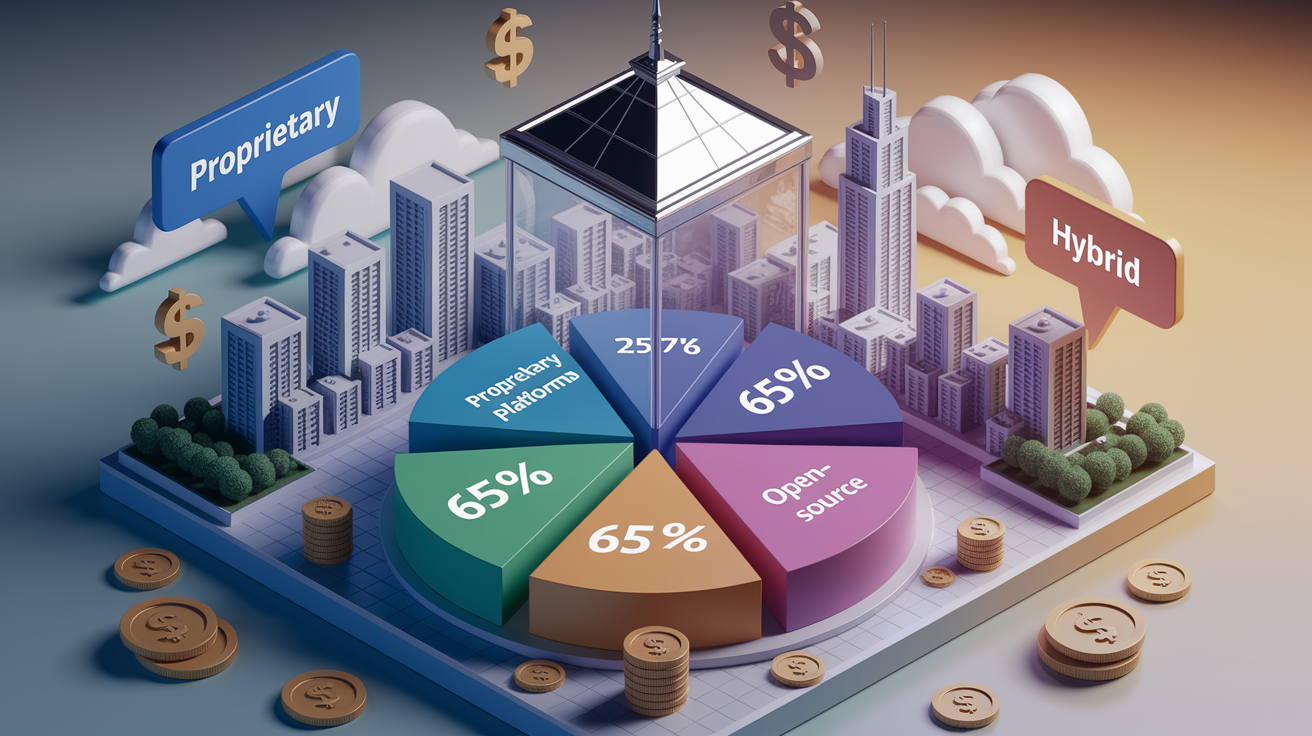
Proprietary AI platforms pulled in somewhere between 65 and 75 percent of big strategic enterprise funding in 2023. OpenAI, Anthropic, and Cohere raised billions to scale compute infrastructure and lock in enterprise distribution. Cohere alone closed a $1 billion round. Anthropic’s AWS partnership brought extra strategic capital tied to cloud compute commitments.
Funding patterns shaping adoption:
- Proprietary platforms: Most venture and corporate money flows to API-first vendors building enterprise SaaS layers and multi-model orchestration tools
- Open-source infrastructure: Growing share of VC rounds back companies commercializing fine-tuning platforms, model registries, and MLOps tooling around open models
- Community-driven: Meta and Mistral drop models without direct monetization, funded by parent-company AI strategy and ecosystem bets
- Hybrid bets: Investors are increasingly backing startups that build on open foundations with proprietary vertical layers, like fine-tuned legal or healthcare models
Growth Trends and Forecasts

Analysts think open-source models will hit 40 to 45 percent market share by 2026. On-device AI deployments, specialized vertical models, and cost-conscious enterprises moving high-volume workloads off metered APIs will push that number up. Smaller efficient models under 10 billion parameters should accelerate things, making it possible to run inference on laptops, phones, and edge hardware without needing cloud connectivity.
Proprietary models will probably keep their lead in high-security enterprise workloads where you need audit trails, compliance certifications, and vendor accountability. The market’s shaping up to segment by use case. Open-source handles volume and experimentation, while proprietary APIs serve mission-critical and customer-facing applications with strict SLA requirements.
Expected shifts through 2026:
- On-device AI: Consumer hardware and mobile operating systems will bake in open models for offline tasks, pushing open-source share higher in endpoint deployments
- Multi-model enterprises: Big organizations will run hybrid setups, routing workloads to open or proprietary models based on sensitivity and cost thresholds
- Specialized vertical models: Industry-specific fine-tuned models (legal, medical, financial) will show up as a third category, mixing open foundations with proprietary training data and domain layers
Final Words
The infographic lays out the market split: open‑source adoption picked up in 2023–24 while proprietary models still dominate enterprise use cases.
It puts adoption, funding, and forecast data side by side for a quick read.
You saw who’s winning in research and startups, which providers lead enterprises, how funding flows, and what growth to expect through 2026.
Keep the open source vs proprietary ai models market share infographic handy when you need a fast visual brief — it clarifies tradeoffs and makes choosing a path easier and more optimistic.
FAQ
Q: What is the current market share split between open-source and proprietary AI models?
A: The current market share split shows open-source adoption accelerating in 2023–2024, while proprietary models still hold a larger share overall, especially across enterprise and regulated industries.
Q: Which open-source models are driving adoption and where are they used?
A: The open-source models driving adoption are Meta’s Llama and Mistral, widely used by research labs, startups, and European teams for customization, prototyping, and cost-sensitive deployments.
Q: Which proprietary providers lead market share and which industries use them most?
A: The proprietary providers leading market share are OpenAI, Anthropic, and Google, and their models are most used in finance, healthcare, government, and other regulated enterprise environments.
Q: Why is open-source AI adoption accelerating?
A: Open-source AI adoption is accelerating because it offers greater customization, lower deployment costs, and faster integration for makers who want control without heavy vendor lock-in.
Q: Why do enterprises still favor proprietary models?
A: Enterprises favor proprietary models because they provide managed services, vendor support, compliance tools, and enterprise SLAs that regulated industries require.
Q: How does funding differ between open-source and proprietary AI projects?
A: Funding differs because proprietary AI receives most venture and corporate capital, while open-source relies on community and ecosystem funding, with more structured investments emerging in 2024.
Q: What growth trends and market shifts should we expect through 2026?
A: Through 2026, expect continued open-source growth driven by decentralization and cost savings, while proprietary models remain dominant in high-security, compliance-heavy enterprise workloads.
Q: How should organizations choose between open-source and proprietary AI today?
A: Organizations should choose based on needs: use open-source for flexibility, lower cost, and customization; use proprietary for managed security, compliance, and vendor support.