


More than 20% of U.S. adults have tried ChatGPT, but many still worry that AI will grab their data or give wrong answers.
An eye-catching infographic breaks down trust and adoption across age, country, and real-world tasks.
It shows awareness tripled since late 2022, trial is growing, and people who use AI report higher satisfaction.
Read on to see where trust breaks down, which features actually win people over, and the simple steps, like clearer data rules and hands-on experience, that nudge curious users into regular use.
Key Consumer AI Statistics at a Glance

More than 20% of U.S. adults have tried ChatGPT. Another 12% say they’re planning to. Awareness has tripled since the tool launched in late 2022, pulling generative AI out of tech circles and into everyday conversation in just over a year. And in the electricity sector, 61% of Americans think AI will be useful for managing energy. That number climbs to 76% among people who’ve already used AI tools.
Global survey data from 19,504 adults across 28 countries (collected November through December 2021) shows a clear split. Developing economies lean optimistic about AI’s benefits. Wealthier nations? More skeptical. Privacy and accuracy sit at the top of the worry list almost everywhere, and deepfakes are climbing fast as a U.S. concern.
- U.S. ChatGPT usage: more than 20% have used it, 12% want to try it.
- Awareness growth: tripled from late 2022 to early 2024.
- Utility sector value: 61% overall, 76% among those who’ve used AI.
- Global divide: developing economies show higher adoption intent and perceived benefit than high GDP countries.
- Top worries: data privacy and accuracy lead, deepfakes and job loss follow.
- Sample details: U.S. electricity survey (1,530 respondents, late June), global survey (19,504 respondents, 28 countries, Nov–Dec 2021).
Those numbers show early interest and lingering caution. People who’ve actually used AI tools report higher satisfaction and see more value. Direct experience matters more than headlines. But the gap between awareness, trial, and regular use stays wide, and privacy concerns anchor almost every conversation about where this goes next.
Consumer Trust and Confidence in AI

Trust swings wildly depending on what AI is doing, who’s using it, and where they live. People trust narrow tasks like spam filters or autocomplete. But they get skeptical fast when AI starts making big calls on loans, medical decisions, or hiring. Transparency about data use and accuracy in the real world push trust up. Opaque algorithms and public failures pull it down.
Among U.S. adults who know what AI is, roughly three quarters see value in energy management applications. Yet privacy remains the biggest barrier to going deeper. The 2021 Ipsos global survey found that people in developing economies start with higher baseline trust. Adoption feels like progress there, not replacement.
- Transparency: clear explanations of data use and decision logic raise confidence.
- Track record: visible accuracy in everyday tools (autocorrect, recommendations) builds trust over time.
- Context matters: practical tasks score higher trust than high stakes or creative work.
- Media coverage: repeated stories about bias, deepfakes, or errors drag down sentiment even when people haven’t personally run into problems.
AI Adoption Trends Across Consumer Segments

Adoption splits along age, tech literacy, and platform comfort. Younger adults (Gen Z and Millennials) show the highest trial rates for generative AI. Older groups adopt slower and prefer AI baked into familiar services rather than standalone chatbots. Urban consumers and those with higher education levels report earlier and more frequent use. Access and comfort with experimental tech both matter.
Between late 2022 and early 2024, awareness of tools like ChatGPT grew three times over. But regular use still clusters in a smaller group. The electricity sector survey found that respondents with prior AI experience valued future AI features at rates 15 percentage points higher than those without. Experience pays dividends. Income and device setup matter too. Households with multiple connected devices and subscriptions adopt faster than those relying on a single smartphone or desktop.
Year over year change shows steady upward movement in trial intent. Growth in daily or weekly use has plateaued in some early adopter segments. The gap between “have heard of” and “use regularly” suggests discovery and initial trial are easier than building lasting habits around AI tools.
Most Common Consumer AI Use Cases
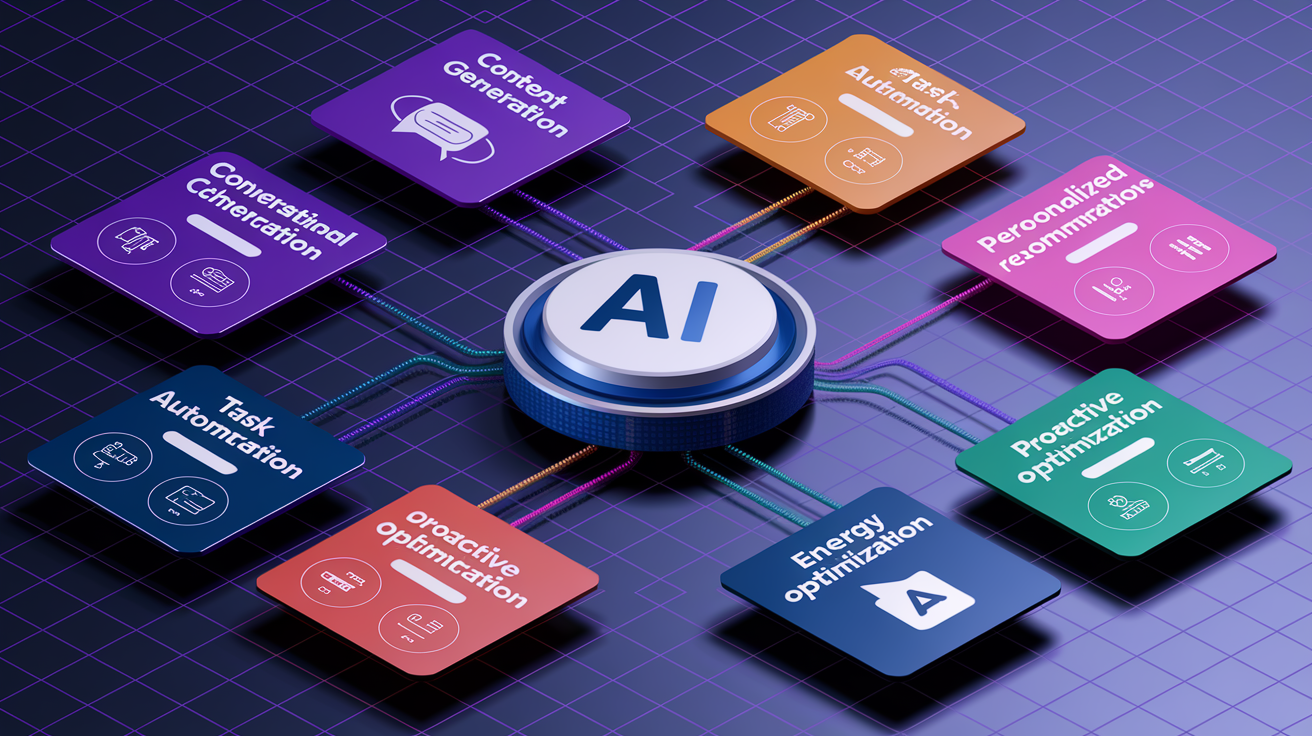
People interact with AI around a handful of everyday tasks, not experimental or cutting edge stuff. These categories reflect what actually happens in routine contexts, not what marketing pushes.
- Conversational chatbots: quick answers, customer service queries, troubleshooting.
- Content generation: email drafts, social media captions, homework help, creative brainstorming.
- Personalized recommendations: shopping suggestions, playlist curation, content feeds.
- Task automation: calendar scheduling, smart home routines, bill reminders.
- Proactive notifications: outage alerts, delivery updates, fraud warnings.
- Energy and resource optimization: utility load shifting, thermostat learning, usage reports.
The electricity survey showed strong interest in proactive outage notifications and personalized energy reduction recommendations. Both align with the broader preference for AI that takes work off your plate rather than adding complexity. Value perception rises when the tool solves a real friction point. Fewer surprises, faster resolutions, or measurable cost savings. It falls when the interface demands new learning or feels intrusive.
Perceived Benefits and Positive Outcomes of AI

People who regularly use AI tools report three main benefits. Time savings through automation. Improved accuracy in routine decisions. Greater personalization that cuts out irrelevant options. In the utility context, 76% of respondents with AI experience see value in systems that optimize energy use or predict equipment failures before outages occur. That compares to 61% among the general population.
Satisfaction tracks closely with transparency and perceived control. When users understand what the AI is doing and can override or adjust recommendations, positive sentiment stays high. Convenience ranks as the most common upside, followed by reduction in manual effort and access to capabilities (language translation, image editing, code generation) that once required specialized skills or software.
Consumer Concerns and Barriers Surrounding AI

Privacy sits at the top of every worry list. People fear AI systems collect more data than necessary, share information with third parties, or store records indefinitely without clear retention policies. Accuracy comes second. High profile examples of chatbot errors, biased recommendations, and fabricated information undermine confidence even among users who’ve never personally encountered a mistake.
Job displacement worries are rising, especially among workers in roles perceived as automatable. Customer service, data entry, content moderation. Deepfake imagery has emerged as a newer concern. U.S. poll questions now ask explicitly: “How concerned are you, if at all, about the effects of realistic looking ‘deepfake’ images of celebrities and public figures spreading on social media?” The rising alarm reflects both media coverage and the ease with which such images now circulate.
Concern severity varies by demographic. Older adults express higher privacy anxiety and lower tolerance for errors. Younger users often trade privacy for convenience but worry more about job impacts and misinformation spread. Education level and prior AI experience moderate these worries. Familiarity reduces fear of the unknown but can sharpen worry about specific risks like algorithmic bias.
- Data privacy: fears about unauthorized access, resale, or indefinite retention.
- Accuracy and errors: concern that AI will provide wrong answers, reinforce bias, or fabricate information.
- Job displacement: anxiety that automation will eliminate roles or depress wages.
- Loss of control: worry that decisions will be made by opaque systems without human review.
- Deepfakes and misinformation: alarm about realistic but false images, audio, or text spreading unchecked.
Demographic Differences in AI Attitudes

Age splits AI sentiment more sharply than anything else. Gen Z and Millennials show higher adoption rates, greater comfort with experimental tools, and more optimism about future applications. Gen X adopts selectively, favoring AI embedded in existing workflows over standalone apps. Boomers report the lowest trial rates, highest privacy concerns, and strongest preference for human alternatives when available.
Income and education amplify these patterns. Higher income households adopt faster, partly because they own more connected devices and subscribe to more digital services. College educated consumers express more nuanced views. They recognize both benefits and risks. Those without degrees tend toward either enthusiastic adoption or outright rejection. Geography matters too. Urban populations encounter AI earlier and more frequently than rural ones, where infrastructure, device penetration, and exposure all lag.
These differences suggest future sentiment won’t converge quickly. Younger cohorts will age into higher AI usage, but older generations are unlikely to match their comfort levels. The experience dividend (higher satisfaction among those who’ve tried AI) means targeted onboarding and transparency efforts could shift attitudes within specific segments. But broad demographic gaps will stick around for years.
Final Words
We opened with topline consumer AI stats—trust, adoption, satisfaction, and main concerns—then covered trust drivers, who’s using AI, common use cases, benefits, barriers, and how attitudes vary by age and income.
Practical takeaway: focus on transparency, clear value, and privacy controls to win users; watch segment trends as younger people adopt faster.
If you need a quick shareable summary, a consumer attitudes toward ai infographic will make those numbers and takeaways easy to scan — and the overall picture looks optimistic if companies act on trust and user control.
FAQ
Q: What are the top consumer AI statistics to watch?
A: The top consumer AI statistics to watch are trust levels, adoption rates, satisfaction percentages, main concerns, likelihood of future use, and demographic differences—these give a quick health check for consumer sentiment and readiness.
Q: How much do consumers trust AI?
A: Consumer trust in AI varies: many people are cautiously optimistic, while a sizable group remains skeptical due to transparency and accuracy worries; trust depends heavily on context and provider reputation.
Q: Who is adopting AI fastest?
A: Younger, tech‑savvy consumers and those in high‑income or tech‑heavy jobs are adopting AI fastest, while older or less tech‑familiar groups lag behind due to comfort and access gaps.
Q: What are the most common consumer AI uses?
A: The most common consumer AI uses are chatbots and virtual assistants, content generation, shopping recommendations, productivity tools, smart home controls, and personalized media or news suggestions.
Q: What do consumers see as the main benefits of AI?
A: Consumers see AI benefits as time savings, task automation, improved accuracy, better personalization, easier decision‑making, and overall convenience that makes everyday tasks faster and simpler.
Q: What are the biggest consumer concerns about AI?
A: The biggest consumer concerns about AI are privacy, misinformation, bias, loss of control, and potential job impacts, with privacy and accuracy usually ranked highest in worry.
Q: How do attitudes vary by age and other demographics?
A: Attitudes vary by age, income, and education: younger and higher‑educated groups show more optimism and adoption, while older or lower‑income groups report greater caution and lower trust.
Q: How can companies improve consumer trust in AI?
A: Companies can improve consumer trust in AI by being transparent about how systems work, offering accuracy guarantees, explaining data use, providing human oversight, and making opt‑out options obvious.
Q: How should I evaluate an AI tool before using it?
A: To evaluate an AI tool, check its accuracy claims, data privacy policy, transparency about decision logic, user controls, third‑party reviews, and whether a human fallback exists for errors.