
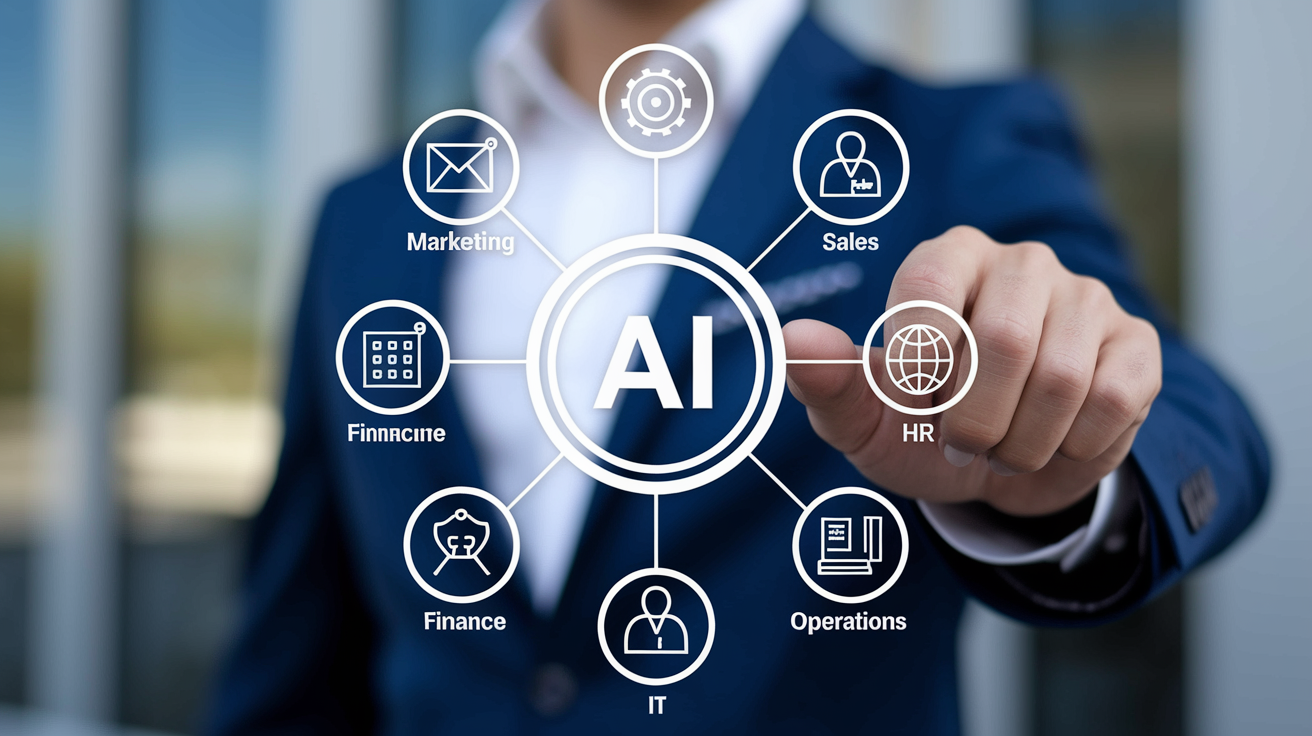

Is AI really reshaping every department, or just the usual suspects?
Our infographic gives a clear answer: it maps the most common AI use cases by business function so you can see where real adoption lives.
More than 60% of organizations now use AI, with customer service, marketing, finance and IT leading deployments.
Read on to benchmark your team, spot high-value starting points, and skip the pilot traps that keep most projects stuck.
At-a-Glance AI Use Cases by Business Department

Enterprises are applying AI in pretty predictable patterns, mostly because they’re chasing the same operational wins. Here’s where each function actually uses AI tools, pulled from adoption data between 2021 and 2024. More than 60% of organizations now use AI somewhere, and customer service, marketing, and IT are out front.
Marketing: Personalization and recommendation engines show up in 68% of deployments. Content generation for ads and social posts hits 55%. Customer segmentation and lifetime value modeling land at 62%. Marketing attribution and media optimization clock in at 48%.
Sales: Lead scoring sits at 60% prevalence. Conversational sales chatbots appear in half of adopting organizations. Sales forecasting and pipeline analytics reach 52%, while deal and pricing optimization lag at 35%.
Customer Service: Virtual agents and chatbots dominate at 72%. Ticket triage and routing reach 60%. Sentiment and voice analytics come in at 44%.
Human Resources: Candidate screening and resume parsing reach 45%. Employee analytics and attrition prediction sit at 35%. Learning and development personalization trails at 28%.
Finance: Fraud detection and anti-money laundering top out at 70%. Risk modeling and credit scoring hit 50%. Automated reconciliation appears in 46% of deployments. Expense and invoice processing with optical character recognition lands at 40%.
Operations and Supply Chain: Predictive maintenance shows up in 65% of adopters. Demand forecasting and inventory optimization reach 58%. Quality inspection using computer vision sits at 38%. Route and logistics optimization comes in at 34%.
IT and Security: Threat detection and anomaly detection reach 66%. Automated incident response hits 54%. IT operations management for performance and capacity lands at 42%.
Product and Engineering: Product analytics and feature prioritization appear in 40% of adopters. A/B testing optimization reaches 48%. AI-assisted coding and automated testing sit at 37%.
This snapshot gives you a quick way to map each department to its most common AI applications. You can benchmark your own adoption and spot high-value starting points.
Department-Specific AI Functions Explained

Marketing teams lean on AI to amplify reach and personalize customer experiences without scaling headcount. Recommendation engines dig through browsing and purchase history to serve tailored product suggestions, driving conversion lifts somewhere between 10 and 30%. Generative AI tools crank out email campaigns, social media posts, and display ads in minutes, cutting content production time by 30 to 60%. Customer segmentation models cluster audiences by behavior and predicted lifetime value, so marketers can allocate spend where it actually matters. Attribution platforms track touchpoints across channels and assign credit using machine learning, optimizing media budgets in real time.
Sales organizations use AI to prioritize high-value prospects and close deals faster. Lead scoring algorithms rank incoming prospects based on historical win patterns and engagement signals, bumping win rates by 10 to 25%. Conversational assistants handle initial qualification calls and answer routine questions, freeing human reps to focus on complex negotiations. Forecasting models analyze pipeline data to predict quarterly revenue more accurately than spreadsheet guesswork. Dynamic pricing engines adjust quotes based on customer profile, inventory levels, and competitive positioning.
Human resources departments apply AI mostly to recruiting and workforce planning. Resume parsers extract skills, experience, and keywords from applications, then rank candidates against job requirements. That cuts initial screening time in half. Attrition prediction models flag employees at risk of leaving, giving managers a window to intervene with retention offers or career development. Personalized learning platforms recommend courses based on role, skill gaps, and career goals, improving training completion rates and employee satisfaction.
Finance functions depend on AI for risk management and process automation. Fraud detection systems compare transaction patterns against known anomalies, achieving detection accuracy improvements of 20 to 60% while reducing false positives. Credit scoring models pull in alternative data sources like payment history and social signals to extend lending decisions to underserved segments. Reconciliation bots match invoices to purchase orders and receipts automatically, eliminating manual data entry and cutting month-end close cycles by days. Invoice processing tools combine optical character recognition with machine learning to extract line items, route approvals, and flag discrepancies without human review.
Operations and supply chain teams use AI to reduce downtime and squeeze more from existing resources. Predictive maintenance algorithms analyze sensor data from equipment to forecast failures 10 to 40% sooner than scheduled inspections, preventing costly unplanned outages. Demand forecasting models ingest sales history, promotions, weather, and external events to predict inventory needs, reducing stockouts and excess holding costs. Computer vision systems inspect products on assembly lines, catching defects faster and more consistently than human inspectors. Route optimization solvers calculate the most efficient delivery paths under constraints like time windows and vehicle capacity, lowering fuel costs and improving on-time delivery.
IT and security departments deploy AI to defend infrastructure and automate operations. Anomaly detection engines monitor network traffic, user behavior, and system logs to identify threats that signature-based tools miss. They often catch zero-day exploits and insider risks. Automated incident response platforms execute predefined playbooks when alerts fire, isolating compromised endpoints and blocking malicious IPs within seconds. AIOps tools correlate performance metrics across cloud services and on-premises hardware, predicting capacity bottlenecks and auto-scaling resources to maintain service levels.
Usage Frequency and Adoption Trends Across Functions

Adoption rates vary sharply by function. Customer service leads at roughly 72% prevalence among organizations using AI in at least one area, driven by the clear return on investment from chatbots that handle routine inquiries around the clock. Marketing and sales follow closely, with personalization and lead scoring appearing in 60 to 68% of adopters. Finance functions, especially fraud detection and automated reconciliation, show adoption near 70% in firms that deploy AI for financial processes. Human resources lags at 28 to 45%, partly because recruitment and retention tools face regulatory scrutiny and cultural pushback.
Generative AI adoption doubled between 2023 and 2024. Content generation and conversational agents now account for 20 to 30% of all AI projects. Machine learning for predictive analytics still represents the largest share at 35 to 45%, but generative applications are growing fastest. Implementation maturity also differs. 35 to 45% of AI initiatives remain in pilot or proof-of-concept stage. 30 to 40% reach departmental rollout. Only 20 to 30% achieve enterprise-wide production. Larger organizations with dedicated AI teams move faster through these stages, while small and mid-market firms stick with packaged solutions that require minimal customization.
| Department | Approx. Adoption % |
|---|---|
| Customer Service | 72% |
| Finance | 70% |
| Marketing | 68% |
| IT / Security | 66% |
| Sales | 60% |
| Human Resources | 45% |
Real-World Examples of AI by Business Function

A global retail chain uses recommendation engines to personalize homepage layouts for millions of shoppers each day. The system analyzes browsing history, cart additions, and purchase patterns, then ranks products by predicted conversion probability. After deploying the tool, the retailer reported a 15% lift in average order value and a 12% increase in repeat purchase rate. A B2B software company built a content generation pipeline that drafts product release notes, blog posts, and email newsletters from engineering changelogs. The marketing team now publishes twice as many posts per month with the same headcount, and engagement metrics improved by 20%.
A financial services firm deployed a lead scoring model that ingests CRM activity, website behavior, and third-party firmographic data. Sales reps get a daily prioritized list of accounts most likely to convert within 30 days. The firm measured a 22% increase in close rates and a 30% reduction in time wasted on cold leads. An insurance carrier uses a conversational assistant to handle policy inquiries, claims status checks, and document uploads. The bot resolves 40% of chats without human handoff, cutting average handle time by 25% and freeing agents to manage complex claims.
A manufacturer installed computer vision cameras on three assembly lines to inspect welds and paint finishes. The system flags defects in real time, reducing rework by 18% and cutting quality-related warranty claims by 12%. A logistics provider runs a predictive maintenance program on its fleet of delivery trucks, using telematics data to forecast brake, tire, and engine failures. The program reduced roadside breakdowns by 35% and lowered maintenance costs by $1.8 million annually. An industrial equipment company built a demand forecasting model that combines order history, seasonal trends, and macroeconomic indicators. Forecast accuracy improved by 14 percentage points, allowing the firm to cut safety stock levels and free up warehouse space.
An enterprise IT team deployed anomaly detection across its cloud environment to catch unusual login patterns and data exfiltration attempts. The tool identified three insider threats and two compromised service accounts within the first six months, preventing estimated losses of over $2 million. A healthcare system uses automated incident response to quarantine infected endpoints and block malicious domains when alerts fire. Mean time to containment dropped from 45 minutes to under five minutes, reducing the blast radius of ransomware attacks and phishing campaigns.
Common Tools Used in Each Function
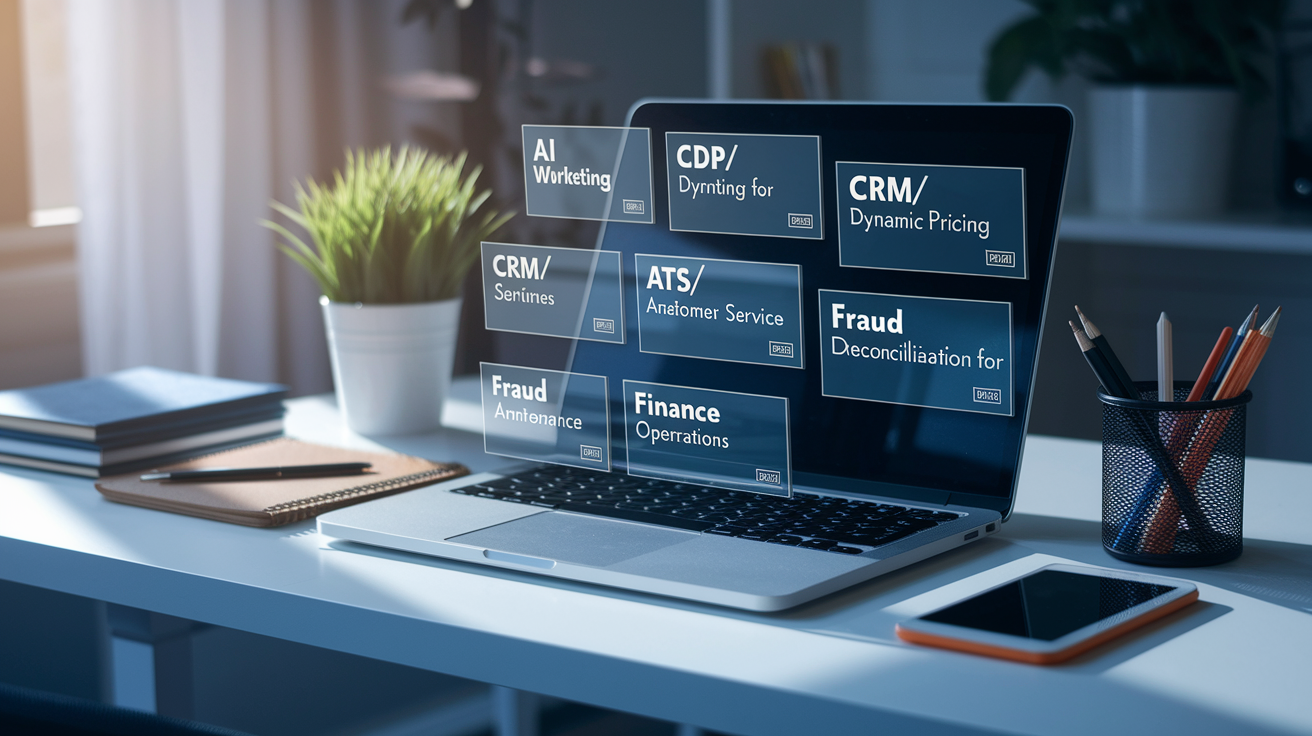
Each department gravitates toward specialized platforms that plug into existing systems and address core workflows.
Marketing: Customer data platforms with built-in recommendation engines, generative AI writing assistants integrated into content management systems, attribution and media mix modeling tools that connect to ad networks.
Sales: CRM extensions for lead scoring and pipeline forecasting, conversational AI bots embedded in chat widgets, dynamic pricing engines that pull from ERP and competitor pricing feeds.
Customer Service: Chatbot builders with natural language understanding, ticket routing platforms that classify inbound requests, sentiment analysis tools that monitor call transcripts and social mentions.
Human Resources: Applicant tracking systems with resume parsing and candidate ranking, workforce analytics dashboards that predict attrition, learning management platforms with personalized course recommendations.
Finance: Fraud detection services offered by payment processors and card networks, automated reconciliation software that matches transactions across systems, invoice processing platforms combining optical character recognition with approval workflows.
Operations and Supply Chain: Predictive maintenance modules in industrial IoT suites, demand planning software with machine learning forecasting, computer vision inspection systems integrated into manufacturing execution platforms, route optimization solvers hosted in cloud logistics services.
These tool categories represent the most frequently deployed AI capabilities within each function. Adoption typically starts with packaged solutions that don’t need data science expertise, then expands to custom models as teams build internal capabilities and collect proprietary training data. Most organizations run a hybrid stack, mixing vendor platforms for common tasks with in-house models for differentiated processes.
Final Words
Across marketing, customer service, IT, HR, finance and operations, AI is already powering content, automation, analytics and faster decision-making. This post gave an infographic-style breakdown, then explained department-specific functions, adoption trends, real-world examples, and common tools.
Use the overview to spot quick wins and prioritize pilots where impact is clearest. Save the most common ai use cases by business function infographic as a quick reference for planning and team buy-in. It’s practical, actionable, and adoption is accelerating.
FAQ
Q: What are the most common AI use cases by department?
A: The most common AI use cases by department include marketing (content, personalization), customer service (chatbots, routing), sales (lead scoring), HR (recruiting), finance (fraud, forecasting), operations, and IT (automation).
Q: How does marketing use AI?
A: Marketing uses AI for creating content, personalizing campaigns, optimizing ad spend, and improving targeting with analytics, helping teams deliver more relevant messages faster.
Q: How does HR use AI?
A: HR uses AI for resume screening, candidate matching, automated onboarding, and employee sentiment analysis to speed hiring and reduce bias when paired with human oversight.
Q: How does finance use AI?
A: Finance uses AI for fraud detection, cash-flow and revenue forecasting, anomaly detection, and automated reconciliations to improve accuracy and catch issues earlier.
Q: How do IT and operations use AI?
A: IT and operations use AI for process automation, incident detection, predictive maintenance, and supply-chain optimization to cut downtime and speed routine work.
Q: How common is AI adoption across business functions?
A: AI adoption across business functions is widespread: over 50% of companies use AI in at least one function, and generative AI usage grew sharply year over year.
Q: What common AI tools do departments use?
A: Common AI tools include CRM automation and ad-generation for marketing, chatbots for support, HR screening platforms, financial anomaly detectors, supply-chain optimizers, and IT observability/automation tools.
Q: How should companies start deploying AI by department?
A: Companies should start by picking a high-impact use case, running a small pilot, measuring outcomes, fixing data or process gaps, and scaling successful pilots with clear governance.