

Think Apple invented the smartphone? Think again.
The first device that looks and acts like a smartphone was the IBM Simon Personal Communicator, built by engineer Frank Canova and his IBM team.
Shown as a prototype in 1992 and sold through BellSouth in 1994, the Simon combined a touchscreen, email, fax, and built-in apps long before iPhone.
This piece explains why Simon deserves the “first smartphone” title, what it got right, and how its short commercial life still shaped the phones we use today.
Definitive Origin of the First Smartphone and Its Creator

Frank Canova, an engineer at IBM, led the team behind the world’s first smartphone: the IBM Simon Personal Communicator. They showed it off as a prototype at COMDEX in Las Vegas back in 1992. Two years later, in August 1994, it hit stores through a deal with BellSouth Cellular. The Simon had the market to itself until February 1995, when IBM pulled the plug. That’s just six months of commercial life.
What made the Simon an actual smartphone instead of just another mobile phone? It did way more than voice calls. You got a touchscreen you could tap with a stylus, email and fax capability, and a bunch of built-in apps like an address book, calendar, appointment scheduler, calculator, and notepad. It even had a predictive keyboard that guessed the six letters you’d most likely type next. Sound familiar? That’s basically where autocomplete got its start.
IBM priced it around $1,099 if you bought it outright, or about $900 if you locked into a two-year contract with BellSouth. They sold roughly 50,000 units in those first six months. But the Simon had some serious drawbacks. Battery life? About an hour of talk time. And you could only use it in the U.S., tied exclusively to BellSouth’s network. Those limits kept it from spreading beyond early adopters and business types willing to deal with constant recharging.
Early Smartphone Features That Defined IBM Simon’s Innovation
The IBM Simon was a chunky thing. Twenty centimeters tall, 6.4 centimeters wide, about 4 centimeters thick, and it weighed over half a kilogram. Most of the front was taken up by a monochrome touchscreen. You controlled it with a plastic stylus, so there weren’t many physical buttons to deal with beyond power and volume.
Here’s what made it qualify as a smartphone instead of just a fancy phone:
- Touchscreen interface where you tapped directly on the screen with a stylus
- Email and fax so you could send messages that weren’t just voice
- Built-in apps like calculator, calendar, address book, appointment scheduler, notepad
- Predictive keyboard that suggested letters to speed up typing
- PDA functions merging organizer tools with wireless communication
- Third-party software support through a PCMCIA slot for loading extra apps
It ran on a 16-bit x86 processor with what we’d consider laughably limited memory now. But it was a total departure from the single-purpose phones everyone else was selling in the early 90s. That one-hour battery meant you had to plan carefully. Lithium-ion batteries and better power management wouldn’t fix that problem for years.
Smartphone Timeline and Historical Milestones After IBM Simon
The journey from the first smartphone to what we carry now passed through a bunch of key moments that expanded what a handheld device could actually do. The Motorola DynaTAC 8000X got FCC approval in 1983 and created the category of portable cellular phones, but it only handled voice calls. And it cost $3,995 and weighed almost two pounds. IBM’s Simon in 1994 added computing power, but the real explosion came after that.
Mobile gaming showed up in 1997 when Nokia shipped the 6110 with Snake. Simple game, but it kicked off what’s now a $100+ billion mobile gaming industry. The Motorola StarTAC launched in 1996 with that flip design and sold over 60 million units worldwide. People wanted smaller, lighter devices. When 3G networks arrived around 2000 and 2001, actual mobile internet became possible. Devices started handling email, web browsing, even video calls. By the time Apple announced the iPhone in 2007 and HTC released the first Android phone in 2008, smartphones had become the multi-function platforms we recognize today.
| Year | Device | Key Innovation |
|---|---|---|
| 1983 | Motorola DynaTAC 8000X | First commercially available mobile phone, FCC approved, 30 minute talk time |
| 1994 | IBM Simon Personal Communicator | First smartphone with touchscreen, email, fax, built-in apps |
| 1996 | Motorola StarTAC | First flip phone, customizable ringtones, 60+ million units sold |
| 1997 | Nokia 6110 | Introduced Snake game, launched mobile gaming era |
| 2007 | Apple iPhone | Full web browser, touchscreen interface, 8 hour talk time, app ecosystem foundation |
| 2008 | HTC Dream (T-Mobile G1) | First Android smartphone, physical QWERTY keyboard, Google services integration |
Comparing IBM Simon, First iPhone, and a Modern Smartphone

The gap between the first smartphone and devices released just over a decade later shows how fast mobile computing advanced once the category took off. The IBM Simon gave you roughly one hour of battery and a monochrome touchscreen. The first iPhone in 2007 promised eight hours of talk time and 250 hours on standby with a color display and a full Safari web browser.
| Device | Key Features | Limitations |
|---|---|---|
| IBM Simon (1994) | Touchscreen with stylus, email, fax, calendar, address book, calculator, predictive keyboard, PCMCIA expansion slot | One hour battery, monochrome display, ~0.5 kg weight, U.S. only availability, no wireless data network support, $1,099 price |
| Apple iPhone (2007) | Multi-touch color display, 4GB or 8GB storage, Safari web browser, iPod integration, 2 megapixel camera, Wi-Fi, 8 hour talk time | No physical keyboard, AT&T exclusivity in U.S., no 3G support at launch, $499 to $599 price, no third-party app support until 2008 |
| Modern Smartphone (2022+) | Multi-core processors, 128GB to 1TB storage, high resolution OLED displays, advanced multi-lens cameras, 5G connectivity, all day battery, extensive app ecosystems | Higher price points ($700 to $1,200+), privacy and security concerns, dependence on constant updates, shorter upgrade cycles |
The leap from the Simon to the iPhone was huge. But the jump from the original iPhone to a 2022 flagship? Even bigger. Modern smartphones carry processing power that rivals desktop computers from a decade ago. They support high-speed 5G data and offer app stores with millions of titles. Battery tech, display resolution, camera systems, wireless connectivity, all of it improved by orders of magnitude. Smartphones became tools for professional photography, mobile gaming, augmented reality, real-time video collaboration. The core features IBM introduced in 1994, touchscreen input, messaging beyond voice, on-device applications, remain at the heart of every smartphone sold today.
Honorable Mentions in the First Smartphone Debate
Several devices sometimes get called the first smartphone, usually because they introduced a feature that became standard later or because they tried early on to merge phone and computer functions. These devices contributed important steps, but they came after the IBM Simon or stayed prototypes that never reached consumers.
The Nokia 9000 Communicator, released in 1996, combined a phone with a full QWERTY keyboard and PDA functions under a clamshell design. The Ericsson GS88, nicknamed “Penelope,” got labeled a “smart phone” on its packaging in 1997. That was the first use of the term, but it stayed a prototype and never got sold. Ericsson’s R380, launched in 2000, became the first device marketed commercially as a smartphone in a modern phone sized form factor. It ran the Symbian operating system and cost around $700. The Danger HipTop, released in 2002 and sold in the U.S. as the T-Mobile Sidekick, offered an early smartphone platform that came before Android hit the market. It built a loyal user base among younger consumers.
- Nokia 9000 Communicator (1996) combined phone and PDA with physical keyboard, came after Simon
- Ericsson GS88 (1997) first device labeled “smart phone,” but only a prototype
- Ericsson R380 (2000) first Symbian smartphone sold commercially, arrived six years after Simon
- Danger HipTop / T-Mobile Sidekick (2002) early smartphone platform, eight years after Simon’s release
These devices advanced specific features like operating systems, compact form factors, or user interfaces. But the IBM Simon holds the distinction of being the first device sold to consumers that combined a phone with a touchscreen, email, fax, and installable applications.
How the First Smartphone Sparked a Mobile Tech Revolution
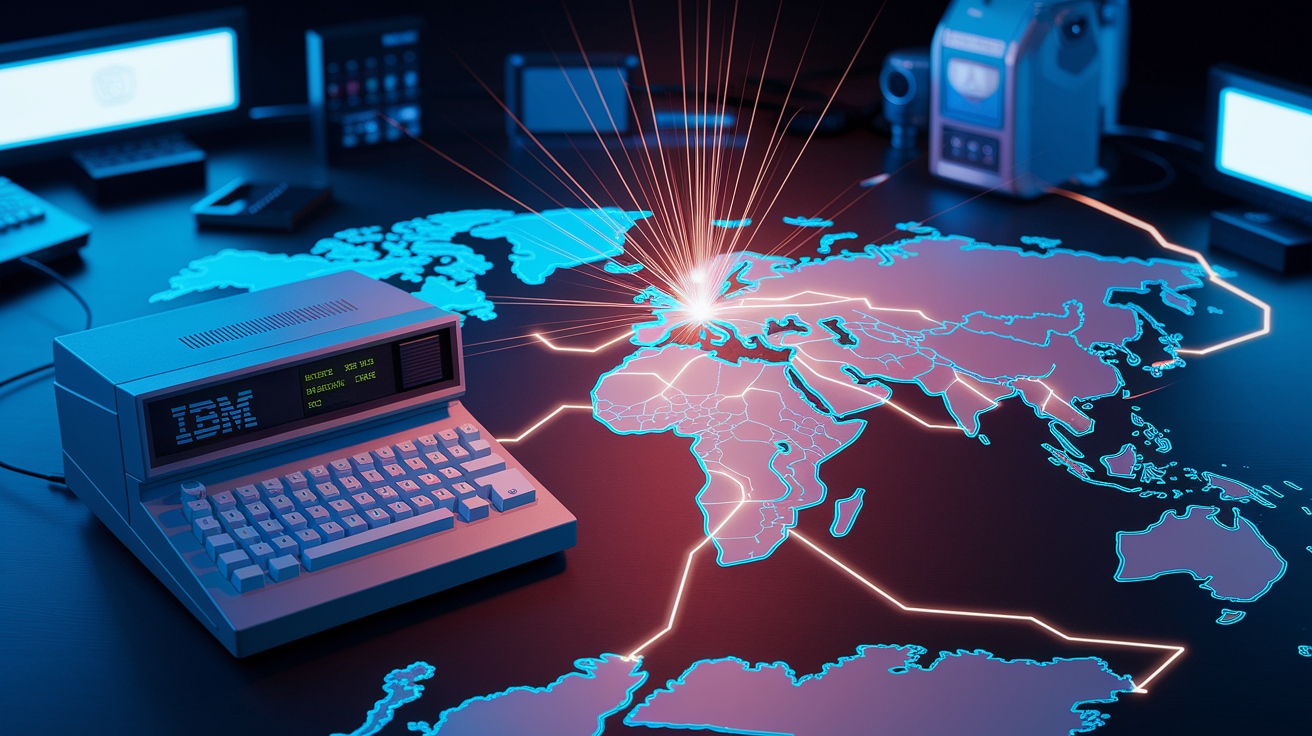
The IBM Simon’s 50,000 units in six months might seem modest compared to the billions of smartphones in use today. But it proved people would pay for a device that did more than make calls. The Simon established the template for combining communication with computing, even if the tech of the early 90s couldn’t yet support mass adoption. Battery constraints, limited network infrastructure, and high prices kept early smartphones in the hands of business users and early adopters. But the concept took root.
When Apple launched the iPhone in 2007 and Google introduced Android in 2008, the smartphone category moved from niche to mainstream in less than a decade. By 2022, hundreds of millions of smartphones were sold annually. Projections estimate more than 6.4 billion smartphone users worldwide by 2029. The shift to smartphones reshaped industries. Mobile advertising, e-commerce expansion, social media accessed primarily through phone screens, remote work normalized through apps like Zoom and Slack. The IBM Simon’s one hour battery and monochrome screen look primitive now. But that device set in motion a transformation in how people communicate, work, shop, and access information. Every app store, every mobile payment, every pocket sized video call traces its lineage back to the moment Frank Canova’s team combined a phone with a touchscreen and a set of productivity tools in 1992.
Final Words
IBM’s Simon, designed by IBM engineer Frank Canova, appeared as a 1992 prototype and reached stores in 1994. It combined a touchscreen, email, fax, calendar and simple apps — the features that make it the first true smartphone.
It sold about 50,000 units early on through BellSouth, cost roughly $1,099 and had a short battery life, but it proved handheld computing could work.
If you’ve wondered who made the first smartphone, the short answer is IBM and Frank Canova, and their breakthrough set the path for the phones we rely on today.
FAQ
Q: Who created the first real smartphone?
A: The first real smartphone was created by IBM engineer Frank Canova: the IBM Simon, prototyped in 1992 and sold in 1994 through BellSouth as the first touchscreen, email-capable device.
Q: Did Apple or Android make the first smartphone?
A: Neither Apple nor Android made the first smartphone; IBM’s Simon debuted in 1994, while Apple’s iPhone arrived in 2007 and the first Android phone launched in 2008.
Q: Which mobile is World No. 1?
A: The mobile that’s world No. 1 is Android by global OS share; Samsung is the top-selling smartphone brand by units, while Apple’s iPhone leads in profit and ecosystem.
Q: Was the iPhone 1 the first smartphone?
A: The iPhone 1 was not the first smartphone; IBM’s Simon (1994) had touchscreen, email, fax, and apps, and sold commercially long before Apple’s 2007 model, which reshaped the market.