

Think satellite on your phone means “cellular anywhere”? Not yet.
Satellite features in phones send short emergency texts and location fixes up to fast-moving LEO satellites, which then relay them to ground stations and into regular networks.
But line of sight, slow delivery, no photos or voice, carrier deals, and regional limits make it a narrow tool, not a full backup.
This piece explains how that link actually works, who can use it, and the real-world limits to expect so you know when it will help—and when it won’t.
Core Functionality of Satellite Connectivity in Newly Launched Devices
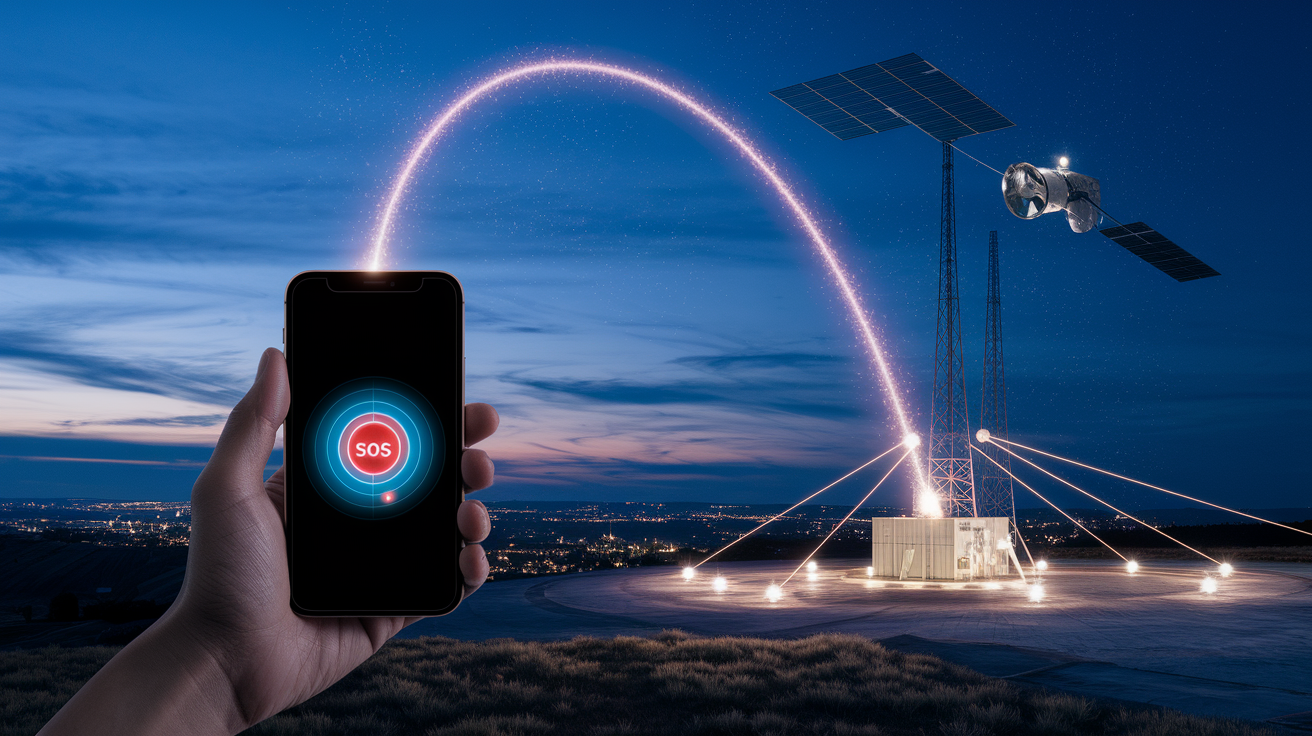
Satellite connectivity in smartphones works by sending emergency messages and location data straight to orbiting satellites hundreds of miles up. The feature showed up first in September 2022 with the iPhone 14, then spread to Android phones like the Pixel 9 series and Samsung Galaxy S25. Your phone emits a radio signal aimed at a satellite passing overhead. That satellite grabs the message and bounces it down to a ground station hooked into fiber networks. From there, the message gets routed to emergency services, roadside help, or whoever you’re trying to reach. Right now you can use Emergency SOS texting, request Roadside Assistance, send your location through Find My, and, starting with iOS 18 in 2024, send limited iMessage and SMS texts. Text only. No group chats, no photos, no videos.
Satellites tear across the sky at roughly 27,000 km/h and orbit somewhere between 300 and 1,200 miles up, depending on the constellation. That means your phone has to point at a moving target while you’re standing outside, away from anything blocking the view. Tall buildings, thick trees, even the way you hold the phone relative to the sky can kill the connection. Satellites pass overhead fast, so your device adjusts beam direction constantly and sometimes hands off to the next satellite in line. If something blocks the signal path, you lose the link.
Latency and data speed don’t come close to cellular. Sending one text message can take 30 seconds or longer depending on whether a satellite’s visible, how long your message is, and how many people are using the network. Bandwidth is tight and shared, so you’re stuck with plain text and minimal data. Multimedia messages, voice calls, and internet browsing aren’t supported on any consumer phone satellite service available right now. T‑Mobile’s T‑Satellite service, powered by Starlink direct to cell, announced that picture messaging, voice, and data are coming later but aren’t available as of mid 2025.
Hardware, Modems, and Ground Network Elements Enabling Satellite Connectivity

Whether your phone can connect to satellites depends on if it’s got a built in satellite modem or if it’s tapping into the carrier’s direct to cell network. Phones like the iPhone 14 and later, plus the Pixel 9 series, pack integrated satellite modems and specialized radio circuitry that lock onto satellite signals without needing carrier help. Other devices like Samsung’s Galaxy S25 need a carrier partnership to access satellite features. Verizon customers with an S25 can send satellite messages through Verizon’s deal with Skylo, but the phone won’t connect if your carrier hasn’t set up a satellite arrangement. T‑Mobile’s direct to cell collaboration with Starlink is different: the network uses Starlink’s constellation to reach your phone using modified cellular protocols, which means “satellite optimized” phones (iPhone 14 and later, Pixel 9 series, Galaxy S24 and newer, Motorola Razr Plus 2024, Galaxy A36 series, Galaxy Z Flip 6, Galaxy Z Fold 6) can connect without needing an extra modem.
Every satellite system needs ground stations to finish the data path. The satellite intercepts your phone’s message and sends it down to a network operations center via downlink. The NOC pushes the message into the public internet or the cellular network core through fiber connections. Operators like Globalstar, Skylo, and Starlink run hundreds of ground stations worldwide, each linked to Internet Exchanges and backbone providers to keep routing fast once the message hits Earth.
Key hardware pieces that make satellite connectivity possible:
Satellite modem chip: integrated radio built to transmit and receive on satellite frequency bands (usually Ku or Ka).
Phased array or high gain antenna: electronically steers the transmission beam toward the satellite without mechanical parts, boosting reliability and cutting weight.
Beam steering algorithms: software that continuously calculates where the satellite is and adjusts signal direction as it moves across the sky.
Ground station network: fiber linked receiving stations that relay messages from the satellite to the internet backbone and emergency response systems.
Service Availability at Launch: Coverage, Supported Features, and Carrier Partnerships
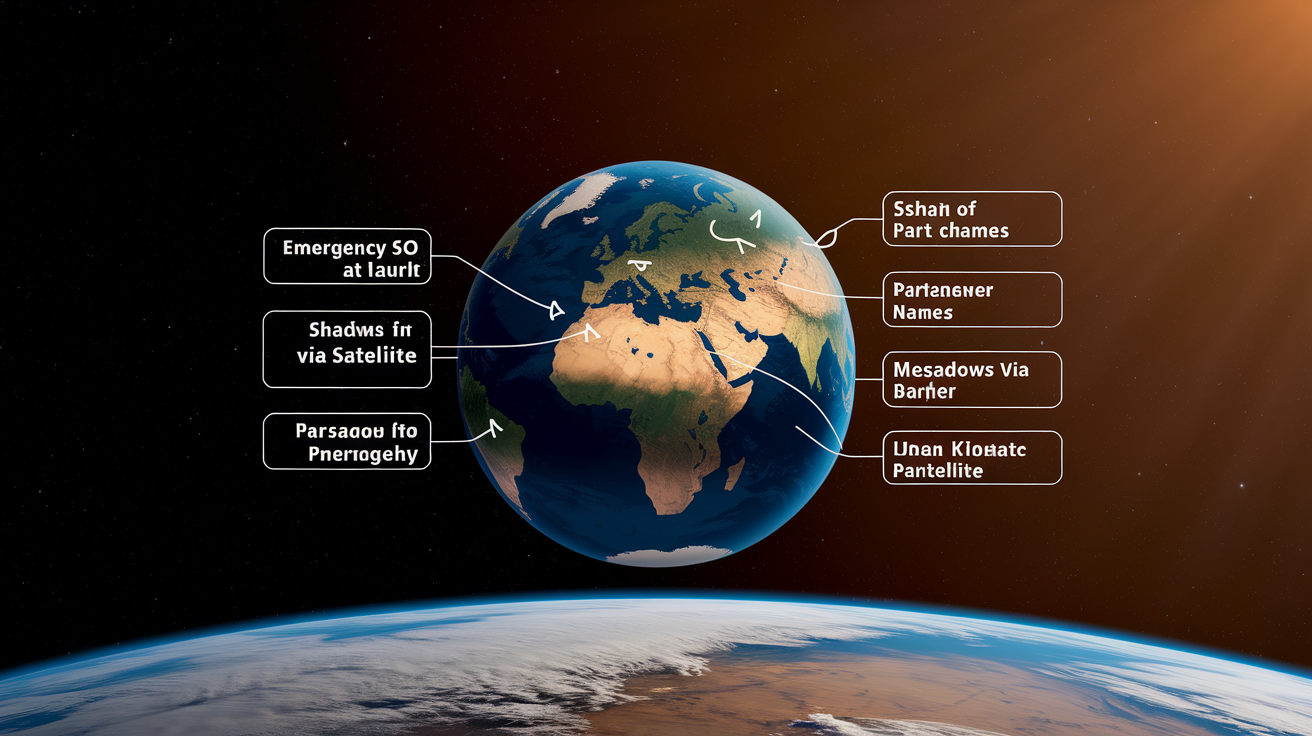
At device launch, whether satellite features actually work depends on three things: the device manufacturer’s partnership deals, carrier support, and regional licensing restrictions. Apple partnered with Globalstar and affiliated third party providers to deliver Emergency SOS and Messages via satellite on iPhone 14 and later models. Apple disables satellite connectivity on devices purchased in or registered to Armenia, Belarus, China, Hong Kong, Macao, Kazakhstan, and Russia. Google’s partnership with Skylo currently limits service to the continental United States for Pixel 9 devices, excluding offshore territories and Alaska. Verizon offers satellite messaging through Skylo to customers with compatible phones (including Galaxy S25 and Pixel 9), and T‑Mobile’s T‑Satellite, built on Starlink’s direct to cell infrastructure, is available on “satellite optimized” phones listed above.
Pricing and trial periods differ. As of May 7, 2025, T‑Satellite is free for customers on T‑Mobile’s Go5G Next or Experience More plans. Customers on other T‑Mobile plans, plus Verizon and AT&T subscribers who activate T‑Satellite as a roaming service, pay $10 per month. T‑Mobile’s earlier beta trial was free and ended on July 22, 2024. Both Apple and Google announced their satellite services would be free for the first two years following each phone’s launch date. After that period, pricing hasn’t been disclosed. Verizon’s Skylo based messaging service was offered at no charge at the time of initial reporting.
| Feature | Coverage Region | Provider Dependency |
|---|---|---|
| Emergency SOS via satellite (Apple) | All countries except Armenia, Belarus, China, Hong Kong, Macao, Kazakhstan, Russia | Globalstar partnership; carrier-agnostic |
| Messages via satellite (Google/Pixel 9) | Continental US only | Skylo; carrier-agnostic on Pixel 9 |
| T-Satellite (T‑Mobile Starlink direct-to-cell) | T-Mobile US coverage footprint | Requires T-Mobile service or roaming agreement; device must be “satellite optimized” |
Network Architecture Differences: LEO vs GEO vs Direct to Cell at Launch
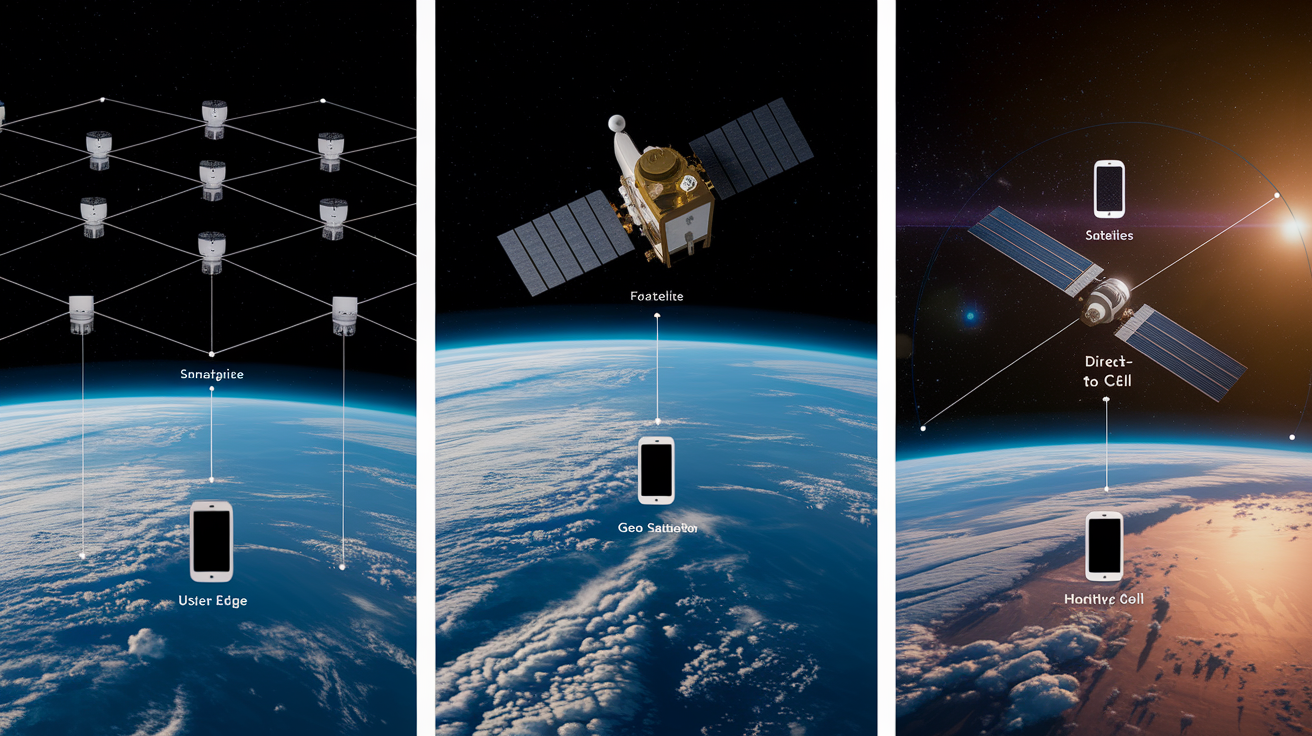
The altitude where satellites orbit determines latency, coverage footprint, and how many satellites you need for continuous service. Low Earth Orbit (LEO) satellites, like those run by Globalstar and Starlink, circle the planet at altitudes between roughly 300 and 1,200 miles. Starlink’s constellation orbits near 550 kilometers (about 340 miles). LEO gives you the lowest latency because signals travel shorter distances compared with geostationary (GEO) satellites parked at about 36,000 kilometers (22,000 miles) above the equator. GEO satellites stay fixed over one point on Earth, so you need fewer spacecraft for global coverage, but the round trip signal delay makes them useless for real time voice, gaming, or video calls. LEO constellations fix the latency problem but add complexity: each satellite races overhead at approximately 27,000 km/h, forcing your phone to hand off connections constantly as satellites rise and set.
Direct to cell systems like T‑Mobile’s T‑Satellite work differently. Instead of needing a dedicated satellite modem in the phone, Starlink’s satellites broadcast modified LTE and eventually 5G signals that standard cellular radios can receive. The satellite acts as a flying cell tower, bridging your phone to Starlink’s space network and down to ground stations without new hardware. This cuts device cost and increases compatibility but introduces new challenges: the satellite must manage Doppler shift compensation, time division multiplexing across thousands of users, and beam handovers as it moves across the sky.
Major differences in how these work:
LEO with integrated modem (Apple/Globalstar, Google/Skylo): dedicated satellite radio inside the phone. Lower latency (roughly 30 to 300 ms for message delivery depending on satellite pass). Requires clear line of sight and outdoor positioning.
LEO direct to cell (T‑Mobile/Starlink): no specialized modem. Satellite speaks standard cellular protocol to the phone. Same low latency benefits as integrated modem systems but bandwidth shared across all users in the beam footprint.
GEO satellite internet (legacy consumer terminals): single satellite serves wide area. Latency around 600 ms or more. Not suitable for emergency messaging but historically used for rural internet access.
Handover frequency: LEO satellites remain visible for 4 to 7 minutes per pass. A single message may be relayed through multiple satellites and ground stations during transmission.
Performance Constraints and Limitations of Satellite Services at Launch
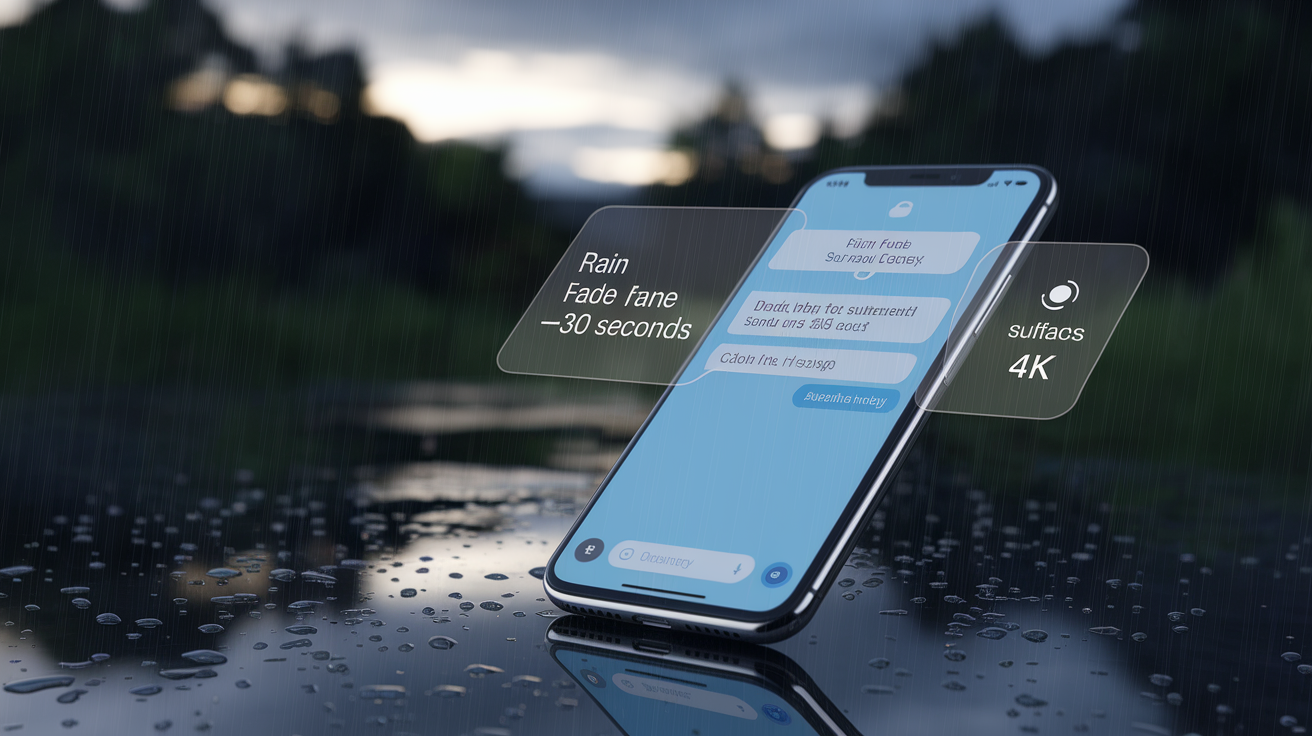
Satellite connectivity in phones operates under strict bandwidth, latency, and environmental constraints. Message delivery can take 30 seconds or more when conditions are ideal and significantly longer if the phone has to search for a satellite after you move indoors or under cover. You can’t send multimedia: photos, videos, and voice calls are blocked on Apple’s Messages via satellite, Google’s Skylo service, and T‑Mobile’s T‑Satellite at launch, though T‑Mobile announced plans to add picture messaging, voice, and data in future updates. Group messaging isn’t supported. Satellite and cellular radios typically don’t operate at the same time, so satellite features activate only when the phone has lost Wi‑Fi and cellular coverage. You can’t force a satellite connection while standing in an area with a working cell tower.
Weather adds more variability. Heavy rain, dense cloud cover, and snow cause “rain fade,” scattering radio signals and reducing link quality. Tree canopy, nearby buildings, and even holding the phone at the wrong angle can block line of sight to the satellite. Offshore coverage gaps exist. Satellite constellations don’t yet provide continuous service over coastal waters and open ocean in all regions. Evening congestion degrades performance as more users try to send messages during peak hours, a problem documented on early LEO internet services and likely to affect phone satellite messaging as adoption grows. Battery life may decrease when the phone is actively searching for satellites or transmitting. Satellite radios draw more power than idle cellular standby.
Primary limitations at launch:
Text only support: emergency texts and basic SMS/iMessage are allowed. No photos, voice calls, or general data.
Line of sight requirement: phone must be outdoors with a direct view of the sky. Indoors, under foliage, or near tall structures block the signal.
Latency: message transmission takes 30+ seconds under good conditions and can exceed several minutes if satellite visibility is intermittent.
Weather sensitivity: rain fade and atmospheric conditions degrade or interrupt service.
No simultaneous cellular use: satellite connectivity is available only when Wi‑Fi and cellular networks are unavailable. You can’t use both at once.
Launch to Service Gap: Why Announced Satellite Features Take Months to Become Usable
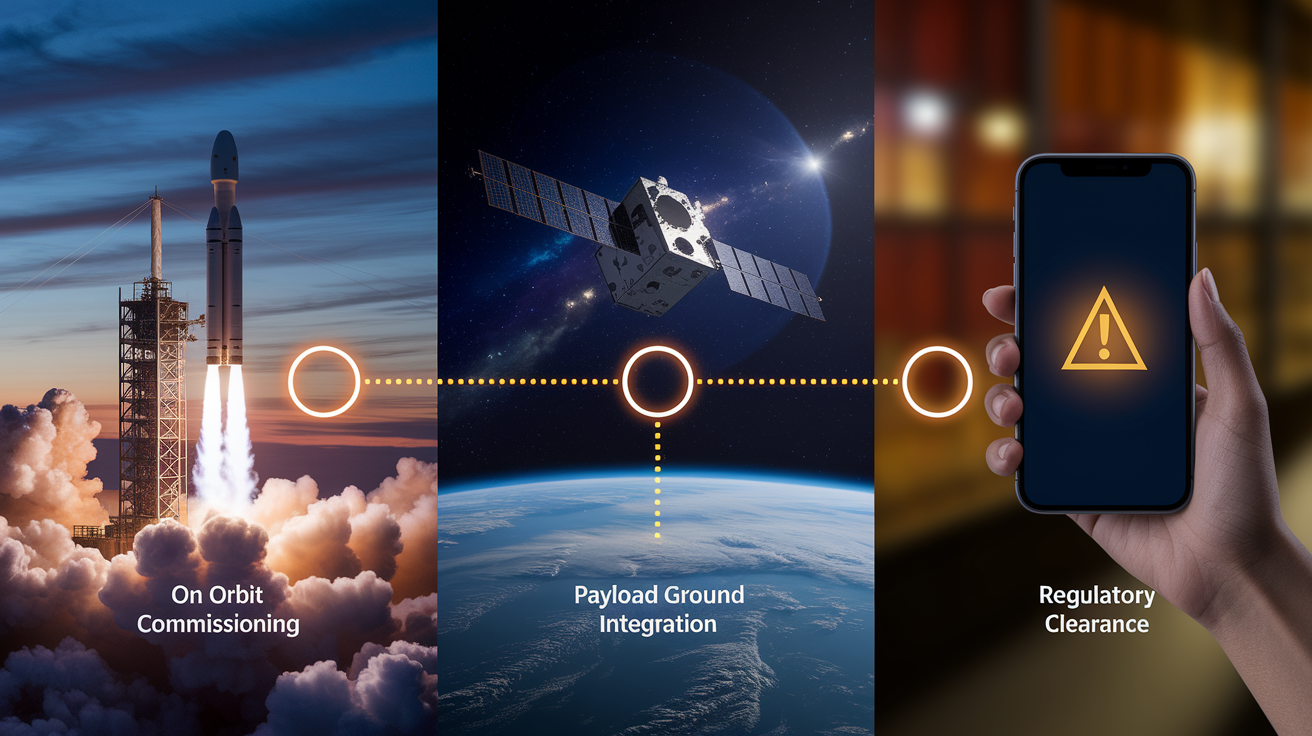
When a satellite operator or device manufacturer announces new satellite connectivity at a product launch event, the service itself often remains unavailable for weeks or months while the constellation undergoes on orbit commissioning. After launch, each satellite must complete health and safety checks, deploy solar panels and antennas, and begin orbit raising maneuvers to reach its assigned altitude and inclination. Engineers monitor telemetry to verify that power systems, propulsion, communication payloads, and thermal controls are functioning as designed. Only after these tests pass does the satellite enter active service.
Once individual satellites are operational, ground teams integrate them into the broader constellation. This includes configuring inter satellite laser links (if the system uses optical crosslinks), coordinating frequency handovers between satellites, and mapping coverage footprints. Operators run live traffic tests using internal terminals to measure message latency, packet loss, and beam steering accuracy before opening service to paying customers. Regulatory bodies in each service country may require additional verification that the network complies with spectrum licenses and interference limits before granting final approval.
On orbit commissioning: satellite deploys antennas, completes orbit raising, and runs self tests (typically 2 to 4 weeks).
Payload commissioning and ground integration: engineers activate communication payloads, test ground station links, and integrate the satellite into network routing tables (additional 2 to 6 weeks).
Regulatory clearance and customer beta: final spectrum coordination, public beta testing with real users, and collection of performance data before general release (timeline varies by country and provider).
Regulatory and Licensing Factors Affecting Satellite Connectivity at Launch

Satellite operators must secure spectrum licenses from national regulators and coordinate frequencies with the International Telecommunication Union (ITU) to prevent interference with existing services. Each country maintains its own licensing regime: operators file applications demonstrating technical compliance, coverage plans, and interference mitigation strategies before regulators grant permission to transmit. If a manufacturer or carrier hasn’t completed the licensing process in a given country by the time the phone launches, satellite features remain disabled in that region. Apple’s exclusion of satellite connectivity in Armenia, Belarus, China, Hong Kong, Macao, Kazakhstan, and Russia reflects either unresolved regulatory barriers or company policy decisions. Google’s limitation of Pixel 9 satellite messaging to the continental United States signals that Skylo’s license and ground infrastructure aren’t yet cleared for broader service.
Launch announcements routinely include disclaimers stating that service availability is subject to regulatory approval and may vary by country, carrier, and device activation location. These disclaimers protect the manufacturer from liability if a feature doesn’t activate immediately or remains unavailable in certain markets. Spectrum coordination can delay launch timelines by months, particularly when orbital slots are contested or when neighboring satellite systems operate on adjacent frequencies and require interference studies before clearance.
Real World Testing, Beta Access, and Verification After Launch
After satellite services go live, operators conduct real world verification tests and solicit feedback from beta users to measure performance under diverse conditions. T‑Mobile’s T‑Satellite beta period, which ended on July 22, 2024, allowed customers on compatible phones to send satellite messages at no charge while the company gathered data on message latency, satellite acquisition times, error rates, and coverage gaps. Apple and Google offered two year free access periods following phone launch dates, encouraging widespread adoption and generating field data on connection reliability, battery impact, and user behavior patterns.
Independent validation efforts have documented real world effectiveness. Satellite emergency messaging was credited with aiding rescues during Hurricanes Milton and Helene, the Los Angeles wildfires, and deadly fires in Maui. Multiple news reports cited cases of lost hikers rescued after sending Emergency SOS texts via satellite. These incidents provide measurable proof that the technology functions as intended in true no coverage scenarios, though they also highlight edge cases where line of sight obstructions or severe weather delayed or blocked messages.
Verification testing includes:
Message latency measurement: timing how long a text takes from send to receipt under varying satellite elevation angles and atmospheric conditions.
Satellite acquisition time: recording how quickly the phone locks onto a satellite after moving from indoors to outdoors.
Error rate and retry logic: counting failed transmissions and observing automatic retry behavior when the first attempt doesn’t reach the satellite.
Coverage gap mapping: identifying geographic coordinates and conditions where service drops or becomes unreliable, including offshore zones, deep valleys, and urban canyons.
Final Words
in the action, we laid out how phones link to space: line‑of‑sight to LEO satellites, specialized antennas and modems, and a ground backhaul that moves messages to your carrier. We covered orbit motion, handovers, latency that can exceed 30 seconds, weather and building blocks, plus the licensing and commissioning that slow rollout.
Quick takeaway: this explains how satellite connectivity announced at launch works and limitations — useful for emergency texts and spotty coverage, not a full cellular backup. Expect gradual improvements.
FAQ
Q: What are the limitations of satellite communication?
A: The limitations of satellite communication are limited bandwidth, high latency (especially for GEO), strict line-of-sight needs, weather and foliage disruption, higher battery drain, limited multimedia support, and inconsistent regional coverage.
Q: How does satellite connectivity work?
A: Satellite connectivity works by a device sending signals to a satellite in orbit, which forwards them to ground stations and fiber back to the internet or another user; it needs a compatible modem, antenna, and clear sky.
Q: Why does SpaceX launch Starlink satellites?
A: SpaceX launches Starlink satellites to create a low-latency global internet network, extend direct-to-cell and broadband coverage, serve consumers and businesses, and generate revenue from satellite broadband services.
Q: What are the 4 types of satellites?
A: The four types of satellites are communications, navigation (GPS), Earth-observation (imaging and remote sensing), and scientific/research (including weather and space science); many also have military or dual-use variants.