


What if Apple put a neon sign on every app saying “we track you”?
Since iOS 14.5, App Privacy Labels force developers to declare what data an app collects and whether it’s used to track users across apps.
That upfront transparency, paired with the App Tracking Transparency prompt, slashed advertisers’ access to IDFA and other cross-app identifiers.
The result: fewer deterministic signals, noisier attribution, higher acquisition costs, and a shift toward first-party data and probabilistic modeling.
This post explains how labels create those limits and what advertisers can do next.
Understanding Apple’s App Privacy Labels and Their Advertising Impact

Apple’s App Privacy Labels break down data collection into three buckets: data used to track you, data linked to you, and data not linked to you. They showed up with iOS 14.5 back in April 2021 and now sit on every App Store product page. Developers have to keep them accurate. The system makes apps declare exactly what personal information they’re grabbing and whether they’re passing it to third parties for ads or analytics.
Data flagged as “used to track you” matters most for advertisers. It’s the stuff that follows users across apps or websites other companies own. Think device identifiers (IDFA being the big one), advertising cookies, location data, whatever gets sent to ad networks or data brokers. If an app says it’s tracking in this category, it has to ask permission through Apple’s App Tracking Transparency prompt before touching those signals.
For advertisers, privacy labels put everything out in the open. That affects user trust and how often people say yes to tracking. A shopping app that lists tons of tracking disclosures? It’ll probably see fewer installs and lower ATT opt-in rates than a competitor with minimal tracking declarations. App-based tracking isn’t invisible anymore.
Here’s how the three label categories matter for advertising:
- Data Used to Track You gets into identifiers and signals shared across apps or websites for ad targeting, measurement, or data brokering. You need ATT permission to access it.
- Data Linked to You covers personal stuff tied to your identity like email, name, purchase history. It’s not necessarily shared for cross-app tracking. Gets used for in-app personalization and first-party segmentation.
- Data Not Linked to You is aggregated or anonymous data that advertisers can’t tie back to individual users. Supports basic analytics but doesn’t give you much for targeting or attribution.
- Advertiser Interpretation means apps with heavy tracking disclosures face pushback from users and lower IDFA availability, which cuts into deterministic cross-app attribution and forces you to lean harder on modeled or first-party signals.
Technical Relationship Between Privacy Labels, IDFA, and AppTrackingTransparency

The Identifier for Advertisers (IDFA) is a unique device-level string that gets assigned to each iPhone and iPad. It’s built to let advertisers track user actions across multiple apps and connect conversions without exposing who someone actually is. Privacy labels show when an app plans to collect IDFA or similar device identifiers by requiring a “data used to track you” disclosure. Once that disclosure goes up, iOS adds a second layer: the App Tracking Transparency prompt, which asks users for explicit permission before the app can grab IDFA. Without permission, IDFA gets replaced with a string of zeroes. Useless for cross-app tracking, retargeting, or deterministic attribution.
The ATT prompt launched in April 2021 with iOS 14.5. Typical opt-in rates sit somewhere between 15% and 25% across most app categories. That means roughly 75% to 85% of iOS users are denying tracking permission. For advertisers, this creates a split environment where a small group provides full deterministic signals while the majority stay effectively invisible to IDFA-based measurement. Privacy labels make this worse because users can review tracking declarations on the App Store listing before they download, which sets them up to be skeptical and less likely to grant ATT permission later.
How Privacy Labels Influence User Opt-In Behavior
When users see that an app collects identifiers, contact info, usage data, and location “for tracking purposes” on the App Store label, they form an opinion before installation. Research shows apps with minimal or no tracking disclosures get higher opt-in rates when the ATT prompt pops up. Apps with extensive tracking labels see steeper permission declines. This pre-installation transparency hands power to the user and introduces a trust variable that didn’t exist before privacy labels became required.
Before tapping ‘Get,’ Emma scans the privacy label and sees the shopping app tracks her location, contacts, and browsing history. She installs it anyway but denies the ATT prompt when asked, reasoning that she’ll still get deals without being followed across the web.
How Privacy Labels Affect Advertiser Tracking and Measurement
Cross-app tracking signals have dropped sharply since privacy labels and ATT became mandatory. When 75% to 85% of users deny permission, advertisers lose access to IDFA for most iOS traffic. That breaks the deterministic link between ad impressions, clicks, and downstream app installs or in-app conversions. Retargeting pools shrink because users who browse a product on one app can’t be reliably identified and re-engaged through ads in another app. Lookalike audience models get worse because seed audiences contain fewer verified conversions, and platforms have less behavioral data to train against.
Attribution modeling gets noisier and more approximate when IDFA isn’t available. Advertisers have to rely on Apple’s SKAdNetwork for app-install campaigns, which gives aggregated, delayed attribution with no user-level detail and limited conversion-event granularity. For web-to-app or multi-touch journeys, measurement gaps widen because the device identifier that used to stitch together a user’s path from a Facebook ad to an App Store visit to an in-app purchase is now missing for most users. Platforms backfill these gaps with probabilistic modeling and statistical inference, but those methods produce estimates, not facts.
Campaign optimization and audience targeting shift from deterministic signals to broader, less precise inputs. Ad platforms still optimize, but they’re doing it on partial visibility. They learn from the 15% to 25% who opted in and extrapolate to the majority who didn’t. This mismatch can bias spend toward audiences or creatives that perform well among opt-in users but might not reflect the behavior of the larger opted-out population. The result is higher cost per acquisition, lower confidence in incrementality, and more reliance on upper-funnel metrics and brand surveys to validate performance.
Categories of Data Most Affected by Privacy Label Disclosures

Privacy labels segment data into functional categories. The ones most relevant to advertising are identifiers, contact information, usage data, and location. Each category directly influences an advertiser’s ability to target, measure, or personalize campaigns.
| Data Category | Effect on Advertising | Typical Disclosure Requirement |
|---|---|---|
| Identifiers (IDFA, Device ID) | Enables cross-app tracking, attribution, and retargeting. Loss removes deterministic measurement. | Must be listed under “Data Used to Track You” if shared with ad networks or third parties. |
| Contact Info (Email, Phone) | Supports first-party CRM matching and custom audience uploads. Does not require ATT if used only within the app. | Listed under “Data Linked to You” unless shared for cross-app tracking purposes. |
| Usage Data (In-App Behavior, Ad Interactions) | Fuels lookalike models and behavioral targeting. Requires ATT if combined with identifiers for cross-app use. | Disclosed under tracking if exported to third-party analytics or ad platforms for user profiling. |
| Location (Precise or Coarse) | Powers geo-targeting and local ad personalization. High user sensitivity drives lower opt-in rates. | Requires tracking disclosure if location is linked to device ID and shared with advertisers or partners. |
Identifiers carry the highest impact because they’re the connective tissue for cross-app journeys. When an app discloses identifier collection for tracking, it triggers both the privacy label warning and the ATT enforcement layer, cutting off most advertisers’ access. Contact information and usage data stay valuable for first-party use but lose much of their cross-platform power once tracking permission gets denied.
Advertiser Challenges Introduced by Privacy Labels
Rising cost per acquisition is one of the most visible consequences of privacy label transparency and reduced tracking permissions. When retargeting pools shrink and lookalike models lose training data, advertisers have to rely on broader, colder audiences that convert at lower rates and need more impressions to drive the same outcome. Smaller e-commerce brands and app-install campaigns have reported CPA increases ranging from 20% to over 50% in the months following ATT enforcement, with the steepest jumps among advertisers who leaned heavily on Facebook and Instagram retargeting.
Measurement accuracy has declined across the board. Advertisers can’t see complete user journeys anymore. Conversions attributed to ads often represent only the subset of users who granted tracking permission, leaving a large blind spot. Delayed and aggregated reporting from SKAdNetwork introduces a 24 to 72-hour lag and restricts granularity to a handful of predefined conversion events, making real-time budget shifts and creative tests slower and less precise. Multi-touch attribution models that once credited assists across several touchpoints now miss most of the upper-funnel interactions, systematically undercounting the value of awareness and consideration channels.
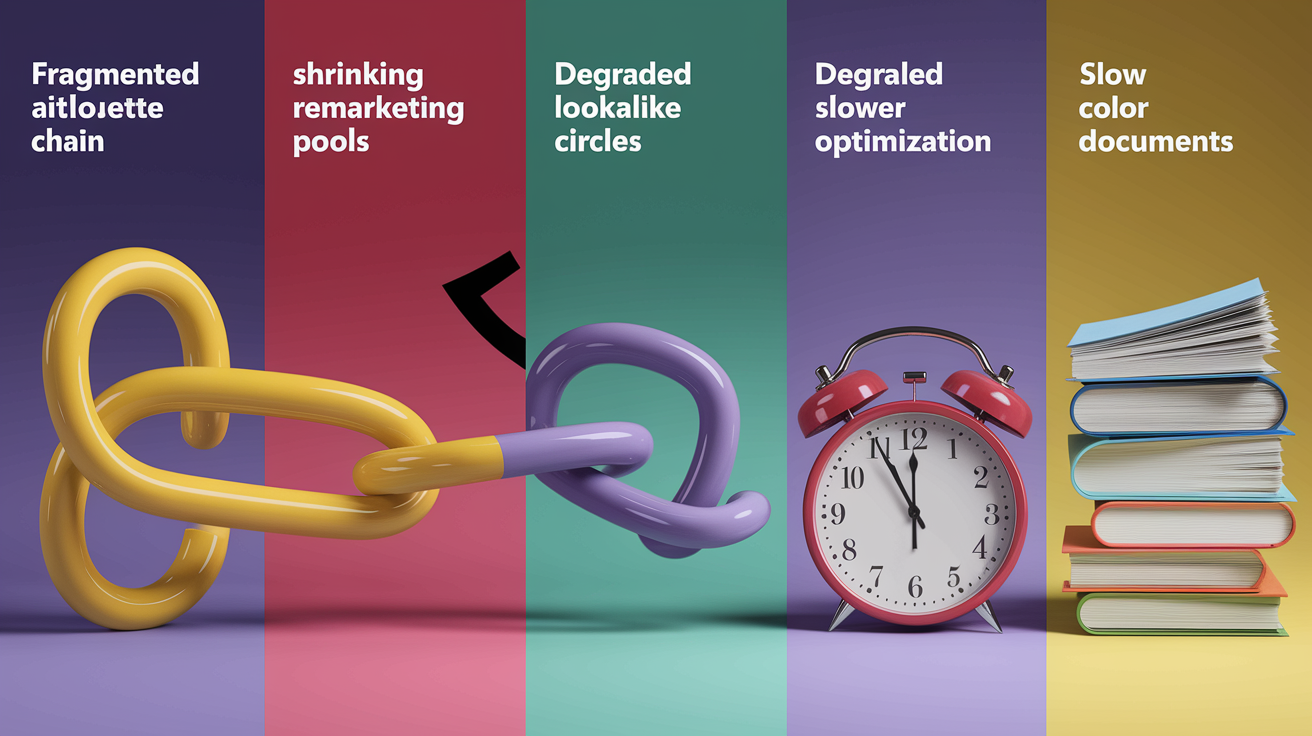
Five key operational challenges advertisers face in the privacy label era:
- Fragmented Attribution where user journeys split across opted-in and opted-out populations create incomplete funnel visibility and conflicting reports between ad platforms and internal analytics.
- Smaller Remarketing Audiences because losing IDFA access for 75%+ of users means retargeting pools are a fraction of their pre-ATT size, reducing reach and frequency options.
- Degraded Lookalike Performance since seed audiences built from partial conversion data produce less accurate lookalike expansions, increasing wasted impressions on low-intent users.
- Slower Optimization Loops as aggregated and delayed reporting lengthens the feedback cycle for creative tests, bid adjustments, and audience refinements.
- Increased Compliance Overhead from keeping privacy labels current, managing ATT prompt timing and messaging, and navigating SKAdNetwork schema updates, which all demand ongoing technical and legal resources.
Strategies Advertisers Can Use to Adapt

SKAdNetwork has become the primary attribution framework for iOS app-install campaigns. Getting the most out of it requires strategic choices about conversion value schemas and campaign structures. Advertisers can configure up to 64 discrete conversion values to represent different user actions or revenue tiers, which lets platforms optimize toward high-value events even without user-level data. Best practices include mapping conversion values to meaningful business outcomes (tutorial completion, first purchase, day-7 retention) and aligning campaign objectives to those values so algorithms learn which creatives and audiences drive the actions that matter most. Because SKAdNetwork reporting is delayed and aggregated, you’ll need longer test cycles. Don’t make budget decisions based on incomplete early signals.
Server-side tracking and first-party data collection have become essential complements to diminished device-level signals. Advertisers who capture emails, phone numbers, or account IDs during app onboarding can upload hashed custom audiences to ad platforms, which enables targeting and measurement that doesn’t depend on IDFA. Implementing server-side event APIs (like Facebook’s Conversions API or Google’s Measurement Protocol) lets advertisers send conversion events directly from their backend systems, bypassing browser or app-level tracking restrictions and improving event match rates. Enriching those server events with first-party attributes like customer lifetime value predictions or product category preferences gives ad platforms richer optimization signals and partially offsets the loss of behavioral tracking data.
Probabilistic modeling and privacy-safe inference are increasingly used to fill attribution gaps, but they have to be applied within platform rules and user consent boundaries. Advertisers can use aggregated cohort analysis, holdout tests, and media mix modeling to estimate the incremental impact of campaigns when deterministic attribution isn’t available. On-device processing frameworks (like Apple’s Private Click Measurement) provide limited attribution for web-to-app flows without exposing individual user data. Some platforms are experimenting with differential privacy techniques that add statistical noise to protect individuals while preserving aggregate trends. These methods yield directional insights rather than precise user-level reports, so you should validate modeled results against business outcomes like total revenue, new-customer counts, and retention rates to make sure the estimates align with reality.
Final Words
App Privacy Labels force apps to list data used for tracking, data linked to users, and data not linked to users. That transparency has already changed user trust and cut the easy signals advertisers once relied on.
For advertisers, that means less deterministic attribution, more modeling, and rising acquisition costs. It also makes label wording part of a user’s install decision.
If you’re wondering how iOS app privacy labels affect ad tracking for advertisers, the answer is clear: they push the industry toward SKAdNetwork, first‑party data, and smarter measurement. It’s a change, but one advertisers can navigate.
FAQ
Q: What are Apple’s App Privacy Labels and the three disclosure categories?
A: Apple’s App Privacy Labels are brief app disclosures; they list three categories: data used to track users, data linked to users, and data not linked to users, showing what apps collect and share.
Q: How does data labeled “used to track” relate to ad networks and cross‑app identifiers?
A: Data labeled “used to track” means the app intends to share identifiers or signals that let ad networks connect activity across apps and sites for targeting and measurement.
Q: How do App Privacy Labels interact with IDFA and AppTrackingTransparency (ATT)?
A: App Privacy Labels reveal intended IDFA use, while ATT requires apps to request permission before accessing the IDFA, so labels show intent but ATT controls actual access.
Q: How do privacy labels and ATT prompts affect user opt‑in behavior?
A: Privacy labels can lower ATT opt‑ins because users see tracking claims before installing, making them less likely to grant permission compared with pre‑ATT expectations.
Q: How do privacy labels affect advertiser tracking and measurement?
A: Privacy labels reduce available cross‑app tracking signals, pushing advertisers toward modeled attribution and decreasing deterministic measurement accuracy for campaigns and conversions.
Q: Which data categories are most affected by privacy label disclosures?
A: Identifiers, contact information, usage and device data are most affected; limits on those types hurt cross‑app linking, audience building, and precise attribution.
Q: What specific challenges do advertisers face because of privacy labels?
A: Advertisers face higher acquisition costs, smaller remarketing pools, loss of deterministic signals, noisier funnel analysis, and tougher audience segmentation and targeting.
Q: What strategies can advertisers use to adapt to these privacy changes?
A: Advertisers should adopt SKAdNetwork, strengthen first‑party data collection, move processing server‑side or on‑device, and use compliant probabilistic modeling for measurement and optimization.
Q: How should advertisers read privacy labels before partnering with or buying app inventory?
A: Advertisers should read labels to identify declared tracking, linked versus non‑linked data, and then adjust targeting, bidding, and measurement plans to match the app’s disclosed practices.